


Retirement changes the shape of a tax return. A paycheck may disappear, but it is replaced by several income streams with different rules, timing choices, and side effects. Looking at any one stream in isolation can produce a misleading answer. The useful question is not simply, “What bracket am I in?” It is, “What happens to the whole return—and to health-care premiums—when the next dollar is added?”
This guide provides a planning map. Tax law changes, state rules vary, and individual facts matter, so confirm decisions with a qualified tax professional.
Key takeaways
- Separate cash flow from taxable income; the account supplying a dollar can change its tax character and downstream effects.
- Model the complete return and effective marginal rate, including Social Security, capital gains, Medicare, and state interactions.
- Use the years before required minimum distributions deliberately, but compare any move across multiple tax years.
- Coordinate withdrawals, conversions, charitable distributions, and Medicare thresholds before acting, then preserve the evidence behind the decision.
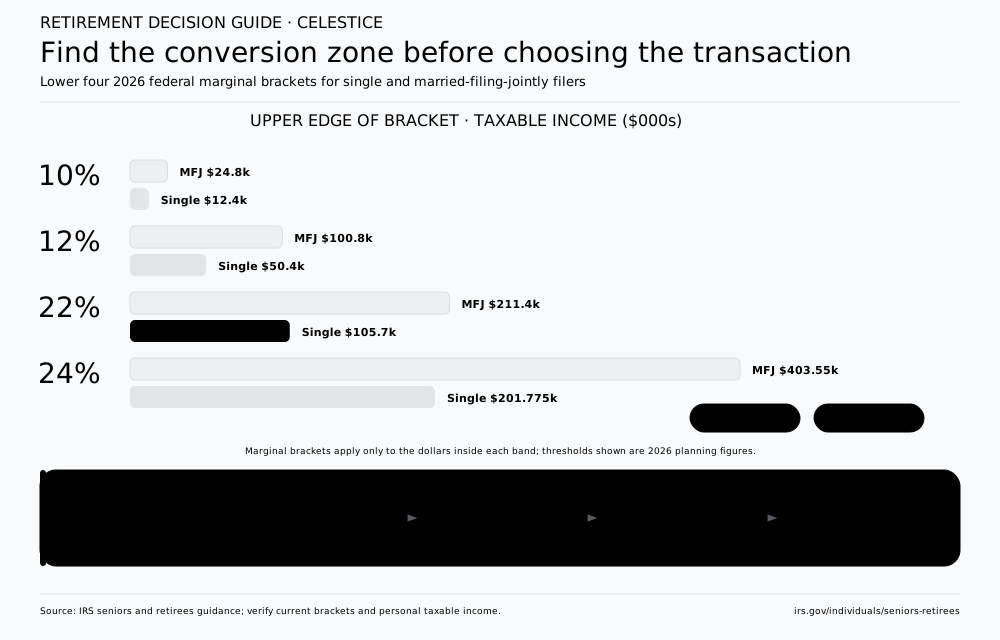
Source: IRS guidance for seniors and retirees. Marginal rates apply only within each band; verify current thresholds, filing status, and personal taxable income.
Map the retirement income stack
Start with the retirement income stack
Build a one-page inventory before evaluating strategies. For every expected source, record its amount, start date, inflation treatment, tax character, and whether you can control its timing.
| Income source | Typical federal treatment | Planning lever |
|---|---|---|
| Social Security | Up to 85% of benefits may be included in taxable income, depending on provisional income | Claiming date and the timing of other income |
| Pension or taxable annuity | Usually ordinary income, except for any after-tax basis | Start date, survivor option, withholding |
| Traditional IRA, 401(k), or 403(b) | Generally ordinary income when distributed | Amount and year; RMDs eventually limit flexibility |
| Roth IRA or qualified Roth plan distribution | Generally federal income-tax-free when qualification rules are met | Preserve or use to manage taxable income |
| Taxable brokerage account | Interest, dividends, and realized gains retain their own character | Tax-lot selection, gain realization, loss harvesting |
| Bank interest and nonqualified annuity earnings | Generally ordinary income | Asset location and withdrawal timing |
| HSA distribution | Tax-free for qualified medical expenses | Save receipts and coordinate reimbursements |
| Work, consulting, rental, or business income | Rules vary; payroll, self-employment, passive-activity, and deduction rules may apply | Timing, expenses, retirement-plan contributions |
Gross cash flow and taxable income are not the same. A $40,000 brokerage withdrawal might include only $8,000 of realized gain, while a $40,000 traditional IRA withdrawal may be fully taxable. Conversely, “tax-free” cash can still influence planning if it changes deductions, available basis, future RMDs, or the assets left for heirs.
Planning insight: The same spending need can produce very different taxable income depending on which account supplies the cash. Compare the full income stack before choosing the withdrawal source.
The hidden interaction: one dollar can cross several thresholds
Tax brackets are marginal: moving into a higher bracket does not subject all prior income to the higher rate. But a withdrawal can have other effects at the same time:
- It can cause a larger share of Social Security to become taxable under the provisional-income formula.
- It can move long-term capital gains or qualified dividends out of the 0% federal capital-gains band.
- It can increase modified adjusted gross income used for Medicare’s income-related monthly adjustment amount, commonly called IRMAA.
- Although retirement-plan distributions are not themselves net investment income, they can raise modified adjusted gross income enough to expose more actual investment income to the net investment income tax or reduce deductions and credits.
- Before Medicare, it can reduce eligibility for premium tax credits on an Affordable Care Act marketplace plan.
- It can change state income tax, property-tax relief, or other income-tested benefits.
The result is an effective marginal rate that can be higher—or occasionally lower— than the tax bracket printed on the return. That is why a tax projection should model the complete return rather than multiply a proposed withdrawal by a headline rate.
Social Security taxation: understand provisional income
Social Security benefits are not taxed in the same way as wages. The federal formula uses “combined” or provisional income: adjusted gross income, tax-exempt interest, and one-half of Social Security benefits, with specific adjustments. Depending on filing status and income, none, up to 50%, or up to 85% of benefits may be included in taxable income. This does not mean Social Security is taxed at an 85% rate; it means as much as 85% of the benefit enters the ordinary-income calculation.
Municipal-bond interest may be exempt from regular federal income tax yet still enter this Social Security formula and the Medicare premium calculation. That is a good example of why “tax-exempt” and “invisible to every threshold” are not the same thing.
Coordinate taxes across years
Required minimum distributions reshape later years
Traditional retirement accounts offer deferral, not permanent exemption. Under current law, original account owners born from 1951 through 1959 generally begin required minimum distributions at age 73; those born in 1960 or later generally begin at age 75. People born earlier became subject to earlier starting ages. Employer-plan details and inherited accounts can follow different rules, so verify the applicable start date and deadline.
An RMD can fill a bracket whether or not the cash is needed for spending. It may also increase taxable Social Security and Medicare premiums two years later. The years after work ends but before RMDs begin can therefore be unusually valuable planning years. Possible uses include realizing long-term gains, taking planned IRA distributions, or making measured Roth conversions. The goal is not automatically to empty a traditional account; it is to compare today’s marginal cost with projected future taxes and preserve useful flexibility.
Roth conversions deserve their own analysis: eligibility, the five-year rules, payment of the conversion tax, estate goals, state residence, and Medicare or ACA thresholds all matter. See our companion guide, Roth Conversions: A Tax-Smart Investing Guide, for the full framework.
A qualified longevity annuity contract, or QLAC, is another specialized tool. Within current limits, an eligible premium paid from a retirement account is generally excluded from that account's RMD balance until contractual income begins, which can be delayed as late as age 85. The objective is longevity income—not merely a smaller near-term RMD. Compare insurer strength, payout and survivor terms, inflation risk, liquidity lost, estate goals, tax treatment, and the opportunity cost of the premium. A QLAC is irrevocable in important ways and is not a universal substitute for diversified assets.
Medicare premiums belong in the tax model
Medicare Part B and Part D income-related surcharges generally use modified adjusted gross income from two years earlier. A large gain, conversion, business sale, or IRA distribution in 2026 can therefore affect 2028 premiums. Married couples should also model the “survivor’s tax penalty”: after one spouse dies, the survivor may have similar income but narrower single-filer brackets and Medicare thresholds.
If income fell after retirement because of a qualifying work stoppage, work reduction, or loss of pension income—or after another qualifying event such as divorce or the death of a spouse—the Social Security Administration provides an appeal process using Form SSA-44. An appeal is not automatic, and not every income change qualifies, but it should be part of the checklist.
Account location and withdrawal source are different decisions
Asset location asks which investments belong in taxable, tax-deferred, and Roth accounts. Withdrawal strategy asks where the next spending dollar should come from. They interact:
- Tax-inefficient interest-producing assets may fit well in a tax-deferred account, but that can build future RMDs.
- High-growth assets in Roth accounts can compound without future federal tax if qualification rules are satisfied, but concentrating one risky asset there can still be imprudent.
- Taxable accounts can offer preferential long-term-gain rates, loss harvesting, and a potential basis adjustment at death under current law.
- HSA assets can be especially valuable when preserved for qualified medical expenses, supported by retained receipts.
The best arrangement reflects expected returns, risk, time horizon, liquidity, estate goals, and tax character—not tax treatment alone.
Charitable giving can coordinate generosity and taxes
For eligible IRA owners, a qualified charitable distribution, or QCD, sends funds directly from an IRA to an eligible charity. A properly executed QCD can count toward an RMD while keeping that amount out of adjusted gross income, subject to current-law limits and requirements. That treatment can be more valuable than an itemized deduction for some donors. Donating appreciated securities from a taxable account may offer a different advantage: avoiding realization of the embedded gain while supporting the charity.
These approaches have strict eligibility, documentation, and timing rules. The check must generally go directly to the charity, and donor-advised funds and private foundations are generally not eligible QCD recipients. Coordinate before assets move.
Do not overlook state and local taxes
States differ widely. Some tax Social Security; many do not. Pension exclusions, retirement-income deductions, capital-gain treatment, estate or inheritance taxes, and property-tax relief vary. A move can also change sales taxes, insurance, housing costs, and access to care, so it should never be justified by income tax alone.
When comparing locations, model at least three views: the annual tax return, total household spending, and the estate or legacy outcome. Establishing domicile requires facts and behavior—not merely changing a mailing address.
Turn the projection into decisions
“Retirement tax planning is not about chasing the lowest tax bill this year. It is about coordinating income across years so more of your money remains available for the life you planned.”
Build a year-by-year tax control panel
A practical annual projection tracks:
- Baseline income: pension, Social Security, interest, dividends, rent, and work.
- Planned portfolio cash: cost basis, realized gains, and ordinary income.
- Mandatory income: RMDs and other distributions with limited timing flexibility.
- Optional actions: Roth conversions, gain harvesting, QCDs, gifts, and charitable contributions.
- Thresholds: ordinary brackets, capital-gain bands, Medicare IRMAA, ACA credits, net investment income tax, and state rules.
- Payment plan: withholding and quarterly estimated taxes, including safe-harbor analysis.
- Next-year effects: carryforwards, future RMDs, Medicare premiums, and account balances by tax type.
Run a base case and alternatives rather than optimizing a single number. A conversion that costs more this year may reduce future RMDs and improve the survivor’s position; a low current bill may simply defer more income into a less flexible year.
A simple example of coordinated income
Imagine a retired couple whose pension, interest, and Social Security cover most core spending. They need an additional $45,000 for travel and a home project. Taking it all from a traditional IRA is simple, but it may increase taxable Social Security and cross a Medicare threshold. Selling only appreciated stock may create a large capital gain and reduce future portfolio diversification. Using only Roth assets may preserve this year’s tax band but consume the account with the greatest future tax flexibility.
A coordinated plan might blend high-basis taxable lots, a measured IRA withdrawal, and Roth cash; donate appreciated shares instead of cash; and defer a discretionary project across two tax years. No single source is universally best. The value comes from seeing the entire stack before acting.
The retirement tax checklist
- Inventory every income source and its tax character.
- Confirm basis in taxable accounts, IRAs, annuities, and employer stock.
- Project at least the current year and the next several years, including RMDs.
- Test Social Security taxation, capital-gain bands, Medicare, ACA, and state effects.
- Coordinate withdrawals, conversions, charitable gifts, and tax payments before December deadlines.
- Revisit beneficiary designations and the different tax treatment heirs may receive.
- Preserve tax returns, Forms 1099, QCD acknowledgments, basis records, and receipts.
- Review the plan after a move, death, retirement, large purchase, business sale, or material market change.
Let Celestice keep the income stack coordinated
The operational problem is timing: account balances, tax projections, Medicare thresholds, charitable instructions, and planned spending often sit in separate systems. A withdrawal that solves this month's cash need can use a valuable bracket, raise a future premium, or leave the surviving spouse with less flexibility.
Celestice does the ongoing coordination after the household sets its goals, assumptions, and decision boundaries. It incorporates connected changes, reruns the multiyear income stack they affect, and looks for threshold pressure or an opportunity that could improve future flexibility. If the current course still works, no new task is created. When a withdrawal mix, conversion, charitable action, or payment decision deserves attention, Celestice brings forward the alternatives and evidence. The household can inspect every assumption, change the proposal, and approve or override it with its tax and financial professionals.
The bottom line
Retirement tax planning works best as a sequence of informed annual choices. When the income stack is visible, taxes become another variable the plan can manage—not a surprise discovered after the year is over.
Subscribe to catch retirement tax trade-offs while choices remain. Celestice handles the connected analysis in the background and surfaces only the tax-sensitive choices worth your attention, with every important decision still in your hands.
Sources and further reading
- IRS: Seniors and retirees
- IRS: Retirement plan and IRA required minimum distributions FAQs
- IRS Publication 915: Social Security and equivalent railroad retirement benefits
- IRS Publication 590-B: Qualified charitable distributions
- SSA: Medicare premiums and higher income
- Fidelity: Taxes in retirement
- Charles Schwab: Managing taxes in retirement
- Merrill: Taxes in retirement
- BlackRock: Tax implications of retirement savings and income
- J.P. Morgan Asset Management: Guide to Retirement 2026