


Retirement guides often begin with hundreds of disconnected facts or one oversimplified savings number. A useful guide should cover the full decision while showing how the pieces affect one another.
Bring recent account statements, a Social Security estimate, any pension information, last year’s tax return, several months of spending records, insurance summaries, estate documents, and a blank planning worksheet. Use reasonable ranges where facts are missing and mark them for follow-up. Precision can improve later; hidden assumptions cannot.
This guide is educational. Benefits, taxes, investments, insurance, and estate law are fact-specific, so use qualified professionals for decisions that require personal advice.
Key takeaways
- Define the life, spending range, and dependable income before choosing investments or a withdrawal rule.
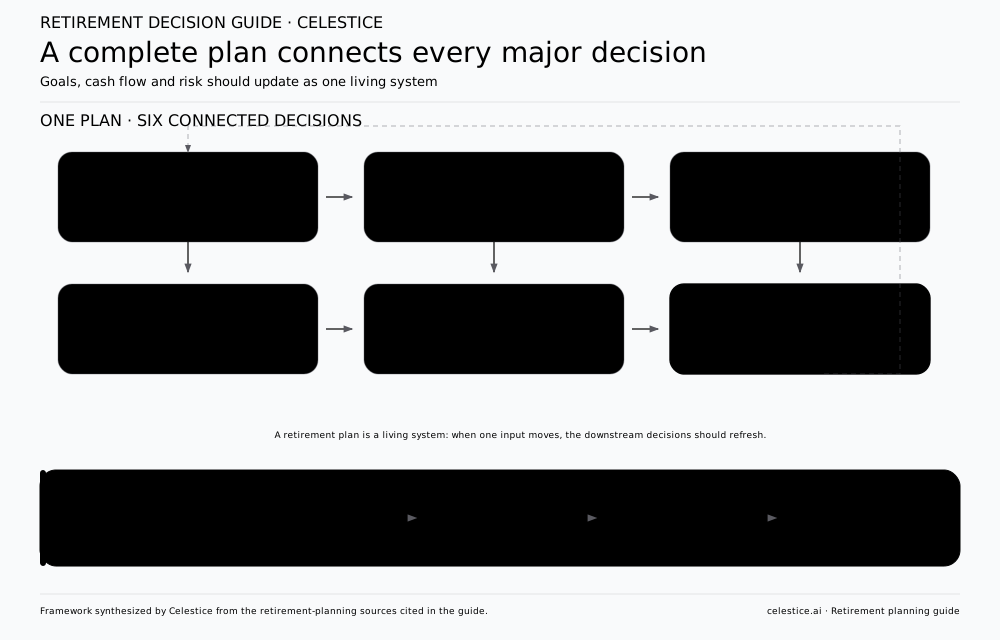
- Treat taxes, housing, health care, insurance, and estate instructions as connected parts of the same household plan.
- Stress-test named setbacks and attach a practical response to every weak result.
- Finish with a one-page decision record and three dated next actions.
Define the retirement and its cash flow
1. Describe the retirement you are funding
Write down what “retired” means before calculating whether you can afford it.
- Target retirement date—and the earliest and latest dates you would accept.
- Where you expect to live, including a possible move or housing transition.
- Work you may continue for income, benefits, purpose, or flexibility.
- Travel, family support, education, charitable, and legacy goals.
- Health, accessibility, caregiving, and long-term-care considerations.
- One-time goals such as a home purchase, renovation, vehicle, or bucket-list trip.
Then label each goal essential, important, or aspirational. That distinction creates adjustment levers. If markets disappoint, essential housing and health care should not compete on equal terms with a flexible trip. If outcomes improve, the plan should show which aspirations can move forward.
Retirement can last 30 years or more for a household. J.P. Morgan’s 2026 longevity data shows why couples should plan to the longer life, not average life expectancy. Use a conservative planning horizon and note family health history rather than selecting the age that makes the plan easiest to fund.
2. Build a retirement spending range
Start with current household spending—not a generic replacement ratio. Mark items that will stop, begin, or change at retirement.
Essential spending usually includes housing, basic food, utilities, transportation, insurance, taxes, and core health care. Flexible spending may include travel, entertainment, gifts, hobbies, and optional upgrades. The labels are personal: time with family may be a core goal even if an accounting template calls the airfare discretionary.
Add expenses that annual averages hide:
- home repairs, vehicles, and other replacements;
- Medicare premiums, supplemental or Advantage coverage, prescriptions, dental, vision, and hearing;
- long-term care or family caregiving;
- taxes on portfolio withdrawals and realized gains;
- support for parents, children, or grandchildren;
- large one-time goals and irregular travel; and
- a contingency allowance for surprises.
Build three annual spending levels: floor, target, and stretch. Also split the first two years into monthly cash flow; retirement bills arrive monthly even when an investment model speaks in annual averages.
Do not assume all categories rise at the same rate. General inflation may differ from health care, housing, insurance, or travel. J.P. Morgan’s spending research also shows that the mix changes with age: some travel and transportation spending may decline while health-care needs can rise. Model the categories rather than imposing an arbitrary straight-line decline.
3. Inventory dependable and flexible income
Create a simple table with source, owner, start date, amount, inflation feature, survivor treatment, tax character, and confidence.
Include:
- Social Security for each spouse;
- pension options and survivor elections;
- annuity or structured guaranteed income;
- wages, consulting, business, or rental income;
- interest and dividends—but do not confuse them with guaranteed cash flow; and
- other reliable sources.
Subtract dependable after-tax income from essential spending. The difference is the essential-income gap the portfolio or another strategy must fund. Then repeat for target spending.
For Social Security, compare claiming at 62, full retirement age, and 70 rather than using one default. Consider longevity, health, work, taxes, portfolio bridging, spousal benefits, and survivor protection. Delaying beyond full retirement age increases the worker benefit only to age 70 under current rules. Claiming early permanently reduces it, and the earnings test can temporarily withhold benefits before full retirement age if wages exceed the current limit. Medicare enrollment is a separate decision; delaying Social Security does not necessarily mean delaying Medicare.
For a pension, compare the monthly annuity with any lump-sum offer using realistic return, longevity, inflation, survivor, liquidity, tax, plan-strength, and legacy assumptions. The largest first payment is not automatically the best household election.
Build the household funding system
4. Assemble the household balance sheet
List every asset and liability. Separate investable assets from property or business value that is not intended to fund spending.
For each account, record owner, type, balance, investments, cost basis where relevant, beneficiary, restrictions, and tax treatment. Include taxable brokerage, traditional retirement accounts, Roth accounts, HSAs, cash, employer plans, annuities, stock compensation, real estate, life insurance cash value, debt, and expected large inflows.
Flag five issues immediately:
- Concentration: too much in one company, sector, property, or strategy.
- Liquidity: insufficient accessible cash for the next year or a known purchase.
- Tax concentration: nearly all wealth in traditional accounts, leaving limited control over future taxable income.
- Debt mismatch: variable or high-cost debt competing with retirement cash flow.
- Disconnected ownership: stale beneficiaries, missing cost basis, or accounts a spouse cannot readily locate.
Net worth is not the same as retirement funding. A valuable home contributes to the plan only through lower housing cost, a sale, downsizing, rent, borrowing, or legacy value. Make the intended role explicit.
If you are still working, add a short accumulation checklist beside the balance sheet. Capture your employee contribution, employer match, vesting status, catch-up eligibility, HSA contribution, and the cost and payoff schedule of debt. Contribute enough to capture the full employer match when practical, then compare additional retirement saving, HSA funding, emergency reserves, and debt repayment by expected return, interest cost, tax treatment, liquidity, and risk. Current annual limits and Roth catch-up rules can change, so verify them rather than copying last year’s figures. Also model the possibility that work ends earlier than planned; a contribution target is not a substitute for an adequate reserve.
5. Design the retirement paycheck
The portfolio’s job is to deliver cash without turning every bill into a market-timing decision. A practical structure has four layers:
- Income floor: Social Security, pension, and other dependable cash cover as much of essential spending as is appropriate.
- Operating cash: checking or money market funds cover upcoming monthly expenses.
- Reserve and near-term funding: cash, short bonds, or a bond/TIPS ladder can cover planned withdrawals and reduce forced sales after a decline.
- Growth portfolio: diversified assets pursue the long-term return needed for later spending and inflation.
Define a starting withdrawal as a planning hypothesis, not a guarantee. Research from Morningstar and J.P. Morgan illustrates that sustainable spending depends on horizon, allocation, market sequence, inflation, fees, taxes, and flexibility. A historical rule of thumb cannot answer all of those questions for one household.
Write two guardrails now. For example: if the funded-status or portfolio value falls beyond a defined level, pause inflation increases or defer flexible spending; if it improves materially, replenish reserves, fund an aspiration, or increase gifts within a tested range. Flexibility has value only when the rule is agreed before markets become emotional.
6. Set the investment and cash policy
Match assets to the jobs above. The allocation needs enough growth for a long horizon and enough stability for near-term withdrawals. Avoid two extremes: holding decades of spending in cash, which exposes purchasing power to inflation, or holding next year’s essential bills entirely in volatile assets.
Record:
- target stock, bond, cash, and other-asset ranges;
- which accounts hold which assets and why;
- 12–24 months of expected net portfolio withdrawals, adjusted for dependable income and personal risk tolerance, as a reserve discussion point—not a universal rule;
- the replenishment source and review trigger;
- a rebalancing policy; and
- a rule for concentrated holdings.
A bond ladder matches maturity values with future spending dates. A TIPS ladder can match real spending while reducing inflation uncertainty. Both require careful attention to maturity dates, reinvestment, credit quality, liquidity, taxes, and the fact that a self-liquidating ladder leaves less principal. An annuity can transfer some longevity risk to an insurer, but trades liquidity and often legacy value for contractual income. Compare tools by the risk they solve, not by yield alone.
7. Map taxes before moving money
Label each account taxable, tax-deferred, Roth, HSA, or other. Estimate this year’s ordinary income, capital gains, taxable Social Security, and required distributions. Then look several years ahead.
The years between retirement and required minimum distributions can create room for planned traditional withdrawals, capital-gain realization, or Roth conversions. But Medicare IRMAA generally uses income from two years earlier, and pre-Medicare marketplace subsidies can be sensitive to current income. State taxes, Social Security taxation, the surviving spouse’s future brackets, charitable QCDs, and heirs’ account treatment also belong in the decision.
Choose a tentative blend, not an immutable order: current income and RMDs first, then selected taxable lots, traditional-account income, and Roth funds in the proportions that meet cash needs while preserving future flexibility. Update withholding and estimated payments alongside the distribution plan.
Protect and maintain the plan
“A retirement plan does not become useful when every uncertainty disappears. It becomes useful when your choices, assumptions, risks, and next actions work together in one living plan.”
8. Cover health care, long-term care, protection, and estate planning
Confirm the path from employer coverage to Medicare. Review enrollment timing, Part B, Part D, Medigap or Medicare Advantage, premiums, deductibles, networks, prescriptions, and out-of-pocket exposure. Medicare generally does not cover ongoing custodial long-term care, so write down who could provide care, where it would happen, what it may cost, and which assets or insurance could fund it.
Many long-term-care policies use a need for substantial help with at least two activities of daily living—such as bathing, dressing, eating, toileting, transferring, and continence—or severe cognitive impairment as benefit triggers. Check the exact policy language, elimination period, covered settings, inflation provisions, and caregiver requirements. Include memory care, decision-making support, powers of attorney, trusted contacts, and protections against financial exploitation before a crisis occurs.
Review life, disability during working years, umbrella liability, homeowners/renters, auto, and long-term-care coverage for the risk each policy is meant to transfer. Keep, change, or drop insurance because the need changed—not simply because retirement began.
At minimum, confirm wills, powers of attorney, health-care directives, account titles, beneficiaries, digital access, and a trusted contact. Beneficiary designations can control retirement accounts regardless of what a will says. Make sure a spouse or executor can find the plan and understand the first calls to make.
9. Stress-test what can go wrong
Test the plan against more than average returns:
- retirement two years earlier than expected;
- a bear market in the first five years;
- inflation above the base case;
- one spouse living to 100 and the other dying early;
- a large health or long-term-care cost;
- lower Social Security than currently scheduled;
- a major home repair or housing move; and
- the surviving spouse’s lower income and single tax brackets.
Monte Carlo analysis can reveal ranges and failure points, but it is not a promise. Pair probabilities with historical stress periods and plain-language consequences: which goal changes, by how much, and when? Read our Monte Carlo guide for a deeper treatment.
10. Choose the next actions and schedule the review
End with decisions, not a larger reading list. Assign an owner and date to the three highest-value actions. Examples:
- request updated Social Security and pension estimates;
- create a complete account and beneficiary inventory;
- measure actual spending for 90 days;
- obtain a tax projection for two claiming or conversion cases;
- establish or right-size the reserve;
- review Medicare and long-term-care funding; or
- update estate documents and emergency access.
Book the next review now—quarterly while approaching retirement, after any major change, and at least annually thereafter.
Turn the complete plan into a one-page decision summary
The full analysis should produce a one-page decision summary containing:
- retirement date range and top goals;
- essential, target, and stretch spending;
- dependable income by start date and survivor treatment;
- essential and target portfolio gaps;
- assets, liabilities, tax types, and major risks;
- preliminary Social Security and pension assumptions;
- cash reserve, withdrawal method, and guardrails;
- investment allocation and rebalancing rule;
- tax, health-care, housing, insurance, and estate flags;
- stress-test results or scenarios still to run; and
- three dated next actions.
Decision rule: A weak scenario is useful only when it identifies the affected goal, the first adjustment, the decision owner, and the date for acting.
That is enough structure to make the next professional conversation dramatically more productive.
Let Celestice do the ongoing coordination
The recurring problem is fragmentation: goals sit in one document, account data in another, tax assumptions in a spreadsheet, and follow-ups in email. When one fact changes, the household may not see which other decisions moved with it.
The plan can default to set-and-forget without becoming a black box. Celestice absorbs connected changes, follows their downstream effects, and carries the source evidence and prior reasoning into the new analysis. If no decision is required, there is no upkeep task. If one is, Celestice explains what moved, which parts of the plan are affected, and what choices are available. The household can drill into the work, alter an assumption, approve or override the next step, and involve financial, tax, legal, or care professionals when useful.
The bottom line
A complete plan avoids the biggest planning mistake: treating retirement as a single number instead of a linked system of life choices, cash flows, taxes, risks, and annual decisions.
Subscribe to put routine plan upkeep on autopilot—not the decisions. Celestice handles the ongoing analysis while you set the direction and retain the final say.
Sources and further reading
- J.P. Morgan Asset Management: Guide to Retirement 2026
- Morningstar: The State of Retirement Income: 2025
- Fisher Investments: Retirement planning resources, including The 15-Minute Retirement Plan, The Investor’s Guide to a Comfortable Retirement, and The Definitive Guide to Retirement Income (2025)
- Social Security Administration: Retirement benefits
- Medicare: Get started with Medicare
- Medicare: Long-term care coverage
- National Association of Insurance Commissioners: Long-term care insurance
- IRS: Seniors and retirees
- FINRA: Retirement accounts
- Investor.gov: Saving and investing for retirement