


A retirement home can be a fresh start: closer to family, easier to maintain, more accessible, or better suited to the life you want now. The financing decision is less romantic. Should you write a check, carry a mortgage, sell investments, or combine all three?
There is no universal winner. The right comparison is not simply mortgage rate versus expected portfolio return. It is the effect of each choice on dependable cash flow, after-tax wealth, liquidity, market risk, future care, and peace of mind.
Housing choices are common rather than exceptional. A Bank of America retirement-housing guide, citing Merrill and Age Wave research, reports that 64% of retirees expected to move at least once during retirement and 37% had already done so. The funding method deserves the same attention as the property.
A recent MarketWatch reader framed the dilemma clearly: at age 68, should she use half of her 401(k) to help buy a $635,000 home and finance the rest? The article's answer sits behind a subscription wall, but the published question is an excellent planning case. It exposes the central issue: a dollar in a pretax retirement account is not necessarily a dollar available for closing, and a home purchase can reshape several years of the retirement plan at once.
Key takeaways
- Compare cash, debt, and portfolio withdrawals using after-tax dollars and the same multiyear assumptions.
- Preserve operating cash, emergency reserves, and money for near-term care before committing capital to the home.
- Stress-test the payment, taxes, and portfolio after a market decline and after the first spouse dies.
- Treat a blended strategy as a real option when all-cash and maximum-debt choices create avoidable concentration or fragility.
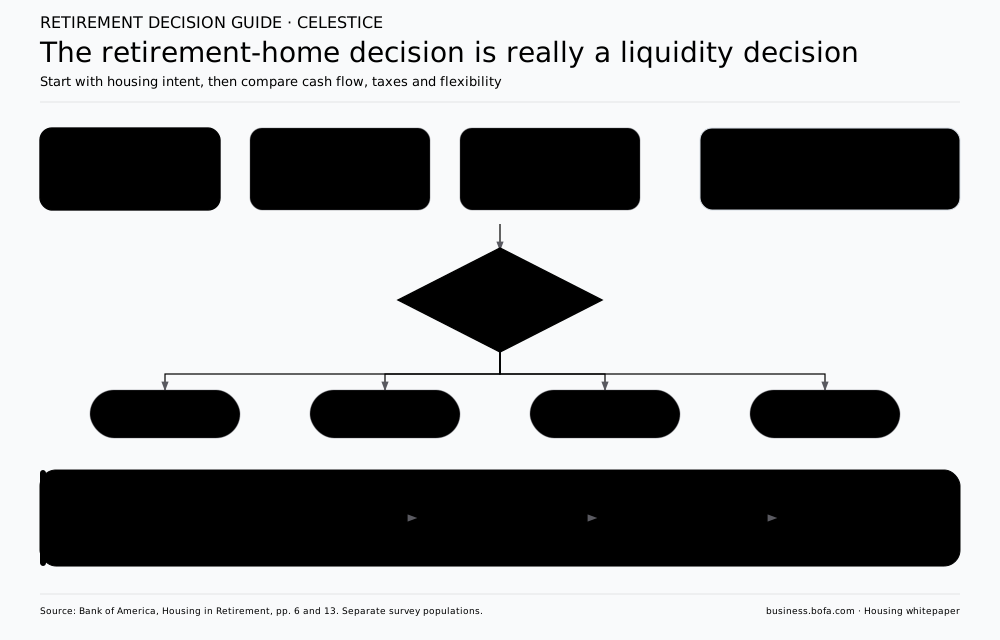
Source: Bank of America, Housing in Retirement. Survey figures use separate populations; test each funding choice with household-specific costs and reserves.
Price the complete housing decision
Before comparing funding sources, price the decision you are actually making. The purchase price is only the opening number. Estimate:
- down payment, closing costs, moving, furnishings, and immediate renovations;
- mortgage principal and interest, including whether the rate can change;
- property tax, homeowners and flood or hazard insurance;
- HOA or community fees, assessments, and their history of increases;
- utilities, routine maintenance, landscaping, and a reserve for major systems;
- accessibility work such as a step-free entrance, first-floor bath, wider doors, better lighting, or grab bars; and
- transportation, health-care access, and possible in-home support.
Insurance availability deserves its own check. A seemingly affordable location can become less attractive if wildfire, wind, flood, or hurricane exposure makes coverage costly, limited, or unavailable. Likewise, a low-maintenance condominium can carry meaningful HOA fees and special-assessment risk. Ask for the association's budget, reserves, insurance, litigation disclosures, and recent meeting minutes before relying on today's monthly fee.
Compare the funding choices
Option 1: Pay cash
Paying cash removes mortgage interest, underwriting, and a required monthly payment. That can make essential spending easier to cover from Social Security, pensions, and other reliable income. It may also make an offer more competitive and reduce anxiety for someone who strongly values being debt-free.
The tradeoff is liquidity. Home equity cannot buy groceries or pay a care bill without a sale or a new loan. A cash purchase can leave too little available for repairs, health costs, travel, taxes, or an extended market decline. It also increases concentration in one property and location. If cash must first be raised from investments, taxes and market timing belong in the price of the house.
Cash is therefore strongest when the purchase still leaves ample liquid reserves, does not compromise the care plan, and can be funded without a damaging tax event or forced sale.
Option 2: Use a mortgage
A mortgage keeps more capital liquid and invested. That flexibility can be valuable when the household may need to fund modifications, help family, bridge to a home sale, or pay for care. A fixed-rate loan also makes the principal-and-interest payment predictable.
But the payment is a claim on future income. Interest is certain; investment returns are not. Carrying a loan may increase the amount the portfolio must supply during a bear market, and qualification, appraisal, closing costs, and insurance requirements add friction. Mortgage-interest deductibility should never be assumed: a taxpayer generally must itemize, and federal limits and acquisition-debt rules apply.
A useful stress test asks whether the payment remains comfortable if one spouse dies, a pension loses its survivor portion, insurance jumps, or the portfolio falls 25%. If the answer depends on selling stocks every month regardless of price, the mortgage may preserve liquidity on paper while weakening resilience in practice.
Option 3: Withdraw from the portfolio
"Use the portfolio" is not one strategy. Account type changes the result:
- Bank cash and short-term securities can provide certainty, but using them may drain the reserve intended for emergencies and near-term spending.
- Taxable investments may create capital gains or losses. Tax lots, holding periods, charitable intentions, and the portfolio's target allocation matter.
- Traditional 401(k) or IRA assets are generally taxed as ordinary income when distributed. The gross withdrawal may need to be substantially larger than the check written at closing.
- Qualified Roth withdrawals generally avoid federal income tax, but they consume assets with valuable tax-free growth and estate-planning flexibility.
A large taxable distribution can push income into a higher marginal bracket, increase the taxable share of Social Security, reduce deductions or credits, and raise income-related Medicare Part B and Part D premiums. Medicare income-related premiums generally use tax-return income from two years earlier, subject to current rules and an appeal process. The effect can persist beyond the purchase year, so model at least a multiyear tax window.
This is why "half the house from a 401(k)" is not equivalent to a 50% down payment. In the $635,000 MarketWatch example, a $317,500 pretax withdrawal could produce materially less than $317,500 after federal and state taxes. Taking even more to cover the tax can amplify the bracket and Medicare effects. Exact results depend on filing status, other income, state law, basis, withholding, and timing.
Stress-test the funding plan
Sequence risk changes the mortgage math
J.P. Morgan's 2026 retirement guide illustrates that identical average returns can produce very different outcomes when withdrawals occur: poor returns early in retirement can do more damage because spending removes shares before they can recover. A large home withdrawal near retirement is another form of spending from the portfolio. If it follows a market decline, the transaction may permanently shrink the recovery base.
The practical response is not to predict next year's market. It is to protect the purchase from becoming a forced sale. Identify the amount already held in cash or short-term assets, the investments that would be sold, the gains or losses embedded in them, and the reserve that must remain afterward. J.P. Morgan's time-segmented framework suggests holding one to three years of the gap between income and spending, plus a cushion for surprises, in the near-term portfolio. A home purchase should not quietly consume that same buffer.
A blended strategy can reduce extremes
The decision need not be binary. A household might use proceeds from its current home, selected taxable lots, and a planned retirement-account distribution for the down payment, then take a manageable fixed-rate mortgage. Another might secure financing, sell the former home, and pay down the new loan after closing if the contract permits it. Spreading taxable withdrawals across calendar years may help in some cases, although interest and market risk continue while the debt remains.
Bridge loans can solve timing problems when one home is purchased before another sells, but they are short-term, typically cost more than conventional financing, and can leave the owner carrying two homes if the sale is delayed. The convenience should be tested against a slower-sale scenario, not just the expected closing date.
Make the decision durable
A six-part decision framework
Score each candidate strategy from weak to strong on these dimensions:
- Monthly resilience. Can dependable income cover essential spending and debt in a difficult year?
- Tax cost. What federal and state taxes arise this year and over the next several years? What happens to Social Security taxation, RMD strategy, and Medicare premiums?
- Liquidity. What remains available after closing for emergencies, repairs, moving, health care, and long-term care?
- Portfolio durability. Which assets are sold, at what gain or loss, and how does the new withdrawal rate behave under an early bear market?
- Housing durability. Can the property accommodate mobility changes, care, and a surviving spouse, or is another move likely soon?
- Legacy and flexibility. How much wealth becomes tied to the home, and would heirs prefer the property, liquid assets, or neither?
Do not let a projected investment return settle the debate. Compare the mortgage's after-tax cost with a range of portfolio outcomes, including losses, and assign value to liquidity. The financially optimal spreadsheet answer can still be wrong if the payment causes persistent stress; peace of mind is a real planning objective, but it should be priced consciously.
Decision rule: Do not make the offer until at least one funding case preserves the household's required reserves, survives the weak-market and survivor tests, and produces an acceptable after-tax monthly cost.
“The best funding choice is not the one with the smallest mortgage. It is the one that leaves the retirement plan resilient after taxes, closing, and the next surprise.”
Home equity and reverse mortgages: later-life tools
Home equity may eventually support renovations, care, or cash flow through a sale, home equity loan, HELOC, or reverse mortgage. These tools are not interchangeable. A home equity loan usually provides a lump sum with payments; a HELOC provides flexible access, often at a variable rate; and a reverse mortgage lets an eligible older homeowner borrow against a primary residence without scheduled monthly principal-and-interest payments.
Reverse-mortgage debt still accrues interest and fees. The borrower must generally keep the home as a principal residence and continue paying property tax, insurance, and maintenance. The balance becomes due after specified events such as sale, permanent move, or death, and using equity can reduce what remains for heirs. Federally insured Home Equity Conversion Mortgages require approved counseling. These are planning tools to evaluate carefully, not free income or a repair for an otherwise unaffordable home.
Before making an offer
Complete this review with the household's financial, tax, mortgage, and legal professionals:
- Obtain realistic loan estimates and verify qualification using retirement income.
- Build a five-year ownership budget with taxes, insurance, HOA, maintenance, and care.
- Calculate the gross withdrawal required to produce the needed after-tax cash.
- Project taxes and Medicare premiums across multiple years, not only at closing.
- Re-run the retirement plan with cash, mortgage, and blended cases under weak markets.
- Preserve separate operating, emergency, and near-term spending reserves.
- Test the survivor case and a move to assisted living or a life-plan community.
- Review title, estate documents, beneficiaries, and any agreement with family contributors.
- Define a walk-away price and do not let sunk transaction costs erase it.
Let Celestice coordinate the purchase as the numbers move
The operational problem is that property details, loan estimates, tax projections, and portfolio trades often live in different places. A purchase can appear affordable in the mortgage worksheet while quietly using the reserve, increasing future withdrawals, or raising Medicare premiums in the retirement plan.
Set the housing requirements, walk-away price, and reserve guardrails once. From there, Celestice carries connected changes to the property, financing, taxes, accounts, and care assumptions through every affected case. If the purchase begins to strain liquidity, Medicare costs, or the survivor plan—or a better funding mix emerges—it returns with the source numbers and trade-offs already assembled. The household can inspect the analysis, change the boundaries, and approve or override the choice alongside its financial, tax, lending, and legal professionals.
This article is educational and is not individualized investment, tax, legal, lending, insurance, or Medicare advice. Rules, rates, and personal circumstances change; consult qualified professionals before acting.
The bottom line
The best retirement-home financing plan is the one that still works after the keys are handed over. A beautiful home should expand retirement possibilities—not consume the liquidity and choices that make those years secure.
Subscribe to let the numbers move without losing the plan. Celestice reruns the household impact in the background and comes back only when a trade-off or approval deserves your attention.
Sources and further reading
- Bank of America: Housing in Retirement—Your Life, Your Choice
- J.P. Morgan Asset Management: Guide to Retirement 2026
- MarketWatch: “I'm 68. Should I spend half my 401(k) to buy a home with a mortgage?”
- Creative Planning: Housing in Retirement—Finding the Right Place to Call Home
- IRS Publication 936: Home mortgage interest deduction
- IRS Topic No. 701: Sale of Your Home
- Medicare: Medicare costs
- Consumer Financial Protection Bureau: Reverse mortgages