


A pension election may be one of the largest and least reversible financial decisions a household makes. The lump sum is visible and emotionally powerful. The annuity can look smaller while quietly providing something expensive: income for however long the covered person lives.
The correct comparison is not the lump sum versus one year of checks. It is the economic and household value of every future payment, including a spouse’s future, adjusted for inflation, taxes, risk, liquidity, and plan terms.
This guide is educational. Obtain the official election package and consider independent actuarial, tax, legal, and financial advice before an irrevocable decision.
Key takeaways
- Normalize the annuity and lump sum to the same survivor benefit, start date, inflation, tax, time-horizon, and risk assumptions.
- Credit the annuity for transferring longevity and investment risk; credit the lump sum for liquidity, control, and legacy flexibility.
- Model both death orders and the loss of purchasing power rather than relying on one break-even age.
- Verify the plan record, protection, and rollover instructions before signing an election that may be irrevocable.
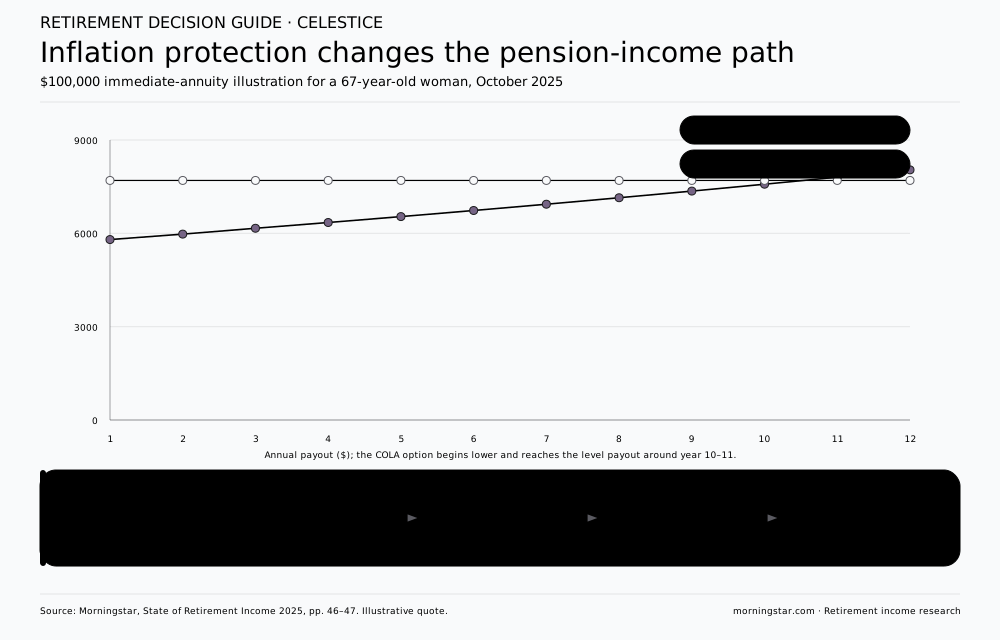
Source: Morningstar, The State of Retirement Income 2025, pp. 46–47. The $100,000 immediate-annuity quote for a 67-year-old woman in October 2025 is illustrative, not a personal offer.
Gather and normalize the choices
Collect the complete election package
Do not rely on a portal headline. Gather:
- lump-sum amount and its calculation date;
- single-life monthly annuity;
- joint-and-survivor options, commonly 50%, 75%, or 100%;
- period-certain, pop-up, or refund features if offered;
- cost-of-living adjustment (COLA), cap, and commencement date;
- early-retirement subsidies or reductions;
- beneficiary and death-before-commencement rules;
- payment start dates and deadlines;
- plan funding notices and summary plan description;
- rollover, withholding, and distribution instructions; and
- contacts for corrections or a formal benefit claim.
Verify service years, compensation, birth dates, marriage data, and beneficiaries. A calculation is only as sound as the employment record behind it.
What the annuity buys
A life annuity pools longevity risk: payments continue even if the retiree lives far beyond average life expectancy. The pension plan manages investments and funding; the retiree does not need to decide what to sell each month. When combined with Social Security, the annuity can cover more essential spending and allow remaining investments to serve flexible goals, inflation, emergencies, and legacy.
That does not make the annuity risk-free. Consider:
- Inflation risk: a fixed payment loses purchasing power over time.
- Survivor risk: a single-life payment may stop at death.
- Plan and sponsor risk: promised and guaranteed amounts are not always identical.
- Liquidity: future checks cannot normally be accelerated for a large purchase.
- Legacy: value may end at the covered death unless the option includes protection.
The decision should credit the annuity for risk transfer while pricing these limitations.
What the lump sum buys
A lump sum can usually be rolled directly to an IRA or eligible plan, preserving tax deferral when executed correctly. It provides investment choice, flexible withdrawals, and remaining assets for beneficiaries. It may help a household with short life expectancy, substantial existing guaranteed income, strong investment capacity, or a major liquidity need.
It also transfers responsibility:
- market and sequence-of-returns risk;
- interest-rate and reinvestment risk;
- longevity and inflation risk;
- portfolio fees and implementation;
- spending discipline and fraud protection;
- RMDs and tax coordination; and
- management by a surviving spouse or agent.
Investment return is not the same as a pension guarantee. A fair comparison uses returns consistent with the certainty of the promised payment, then separately tests the upside and downside of a diversified portfolio.
Compare lifetime and survivor outcomes
Compare equivalent survivor options
Comparing a single-life pension with a lump sum intended to support two lives is not apples to apples. Start with the annuity option that matches the household’s survivor need.
A joint-and-survivor election pays less initially but continues a stated percentage after the retiree dies. Review whose life determines the reduction, whether payments “pop up” if the spouse dies first, and whether the election can be changed after commencement. Federal rules generally require spousal consent for certain alternatives in qualified plans.
Model both death orders. At the first death, one Social Security check usually ends, tax filing status may become single, and some expenses remain. The survivor percentage should be chosen from that cash-flow need, not from a desire to maximize today’s check.
Life insurance is sometimes proposed as “pension maximization”: choose the single-life annuity and insure the spouse. Compare premiums, insurability, policy guarantees, lapse risk, tax treatment, and the survivor’s income need. Do not assume an illustration makes the strategy certain.
Test the implied return carefully
A useful analysis discounts expected annuity payments back to today at an appropriate rate. For a basic screen, calculate how long cumulative payments take to equal the lump sum—but do not stop there. A simple break-even ignores the time value of money, payments after break-even, taxes, survival probabilities, COLAs, and investment risk.
Build several present-value cases:
- retiree lives to a shorter age;
- retiree reaches average or above-average longevity;
- either spouse lives to an advanced age;
- fixed versus actual plan COLA;
- low-risk discount rate versus a diversified portfolio scenario; and
- fees, withdrawals, and taxes on the invested lump sum.
Lump-sum values often change with interest rates because plans use legally prescribed assumptions: higher discount rates generally reduce the present value of future payments, all else equal. Ask when the rate is set and whether delaying the election changes service, subsidies, age factors, or the calculation basis.
Inflation changes a fixed pension’s job
A $5,000 monthly payment may feel substantial today, but a fixed amount buys less after 20 or 30 years. Estimate the real value at several inflation rates. If the pension lacks a COLA, keep growth assets or inflation-linked income elsewhere rather than expecting the pension to fund the same lifestyle forever.
A plan COLA may be fixed, capped, delayed, or conditional; it may not match the Consumer Price Index. Read the exact language. Social Security’s COLA can help but does not make an unrelated fixed pension inflation-protected.
Fit the election to the essential-income floor
Add Social Security and other dependable income to each pension option. Compare the result with essential spending under three household states: both spouses alive, retiree dies first, spouse dies first.
If the annuity closes a large essential-income gap, its longevity protection may have high value. If essential spending is already covered by Social Security and another pension, the household may place greater value on lump-sum liquidity and legacy. This is the marginal value of guaranteed income: the same pension can play a different role depending on what the household already owns.
J.P. Morgan’s 2026 retirement research notes that households with more guaranteed income may feel more confident spending. Morningstar’s 2025 work similarly shows the trade-off: annuities can support lifetime consumption, while the purchase reduces liquidity and median ending wealth in many scenarios.
Test implementation and household risk
Taxes and rollover mechanics
Monthly pension payments are generally ordinary income except to the extent a retiree has recoverable after-tax basis. A taxable lump-sum distribution paid to the participant can trigger mandatory withholding and current income tax, and an additional tax may apply before the relevant age unless an exception applies.
A direct rollover to an IRA or eligible employer plan can generally continue tax deferral. Future withdrawals are then taxed under the receiving account’s rules and may be subject to RMDs. Employer stock, after-tax contributions, Roth amounts, and nonqualified plans can require specialized analysis. Confirm state taxation and creditor-protection differences before moving assets.
Taxes should be modeled across years. A lump sum rolled to an IRA may increase future RMDs; an annuity creates steady ordinary income. Either can affect taxable Social Security, Medicare IRMAA, and the surviving spouse’s brackets.
Evaluate plan protection—not just the employer’s brand
Private-sector defined-benefit plans may be insured by the Pension Benefit Guaranty Corporation, but not every pension is covered and PBGC guarantees have legal limits that depend on plan type, age, form, and termination year. State and local government pensions, church plans, multiemployer plans, and other arrangements follow different regimes.
Read the plan’s annual funding notice, identify whether PBGC coverage applies, and compare the promised benefit with applicable guarantee limits. A strong sponsor does not remove every risk, and a weak sponsor does not automatically mean the lump sum is best. Use the facts of the plan.
“A pension election is not a contest between a big check and a monthly check. It is a decision about which risks the plan keeps, which risks the household accepts, and what the survivor needs.”
Health, liquidity, legacy, and behavior
Health and longevity. A serious diagnosis can favor liquidity or legacy, but survivor needs may still support a joint annuity. Use household, not individual, longevity.
Liquidity. Keep adequate reserves for housing, care, and emergencies. An irrevocable annuity cannot normally fund a sudden large expense.
Legacy. A lump sum can leave remaining assets, while many annuity options end after the covered lives or period. But maximizing inheritance should not jeopardize the survivor’s own income.
Behavior and capacity. A dependable monthly payment can reduce the complexity of managing investments at advanced ages. A lump sum may be suitable when the household has a sound withdrawal process, trustworthy support, strong fraud controls, and a portfolio the survivor can manage.
Make the election
A side-by-side decision scorecard
Score each option from strong to weak for the household—not in the abstract:
| Factor | Monthly annuity | Lump sum / rollover |
|---|---|---|
| Lifetime income | Plan bears longevity risk | Household bears longevity risk |
| Investment risk | Primarily plan/sponsor | Household portfolio |
| Inflation | Depends on COLA | Can invest for inflation, with risk |
| Liquidity | Usually limited | Flexible, subject to markets/tax |
| Survivor | Depends on elected percentage | Remaining account is flexible |
| Legacy | Often limited | Remaining assets can pass to heirs |
| Complexity | Lower monthly management | Allocation, withdrawals, RMDs, fees |
| Protection | Plan and possible PBGC limits | Custody/account protections; no return guarantee |
Then run three quantitative cases and a survivor budget. If the answer changes under a small assumption adjustment, that sensitivity is itself important.
Decision rule: Do not sign until the annuity and lump sum use the same survivor, inflation, tax, time-horizon, and risk assumptions—and the selected option still works for the household after the first death.
Questions to answer before signing
- Is the choice irrevocable, and when is the deadline?
- What records drive the benefit, and have they been verified?
- Which options include COLAs, survivor payments, guarantees, or pop-up features?
- What income does the survivor need after Social Security and other pensions change?
- How was the lump sum calculated, and what date and rates apply?
- Is the plan PBGC-covered, and how does the benefit compare with guarantee limits?
- What direct-rollover steps avoid unintended withholding or tax?
- How do both options affect RMDs, Medicare, state tax, and heirs?
- Who will manage the assets at age 85 or after incapacity?
- Does the household already have enough dependable income and liquidity?
Let Celestice keep the election analysis current
The practical difficulty is that the election package, survivor budget, tax projection, and portfolio assumptions are often reviewed separately. That can make a large lump sum look more flexible than it is—or make an annuity look safer without testing inflation, plan protection, and the surviving spouse's income.
Connect the election package and household priorities once. Celestice normalizes the choices and carries each connected change through the survivor, tax, inflation, and portfolio cases. It stays out of the way until the conclusion moves or the deadline calls for a decision, then supplies the relevant source documents, math, and trade-offs. The household can alter an assumption, approve or override the proposed election, and bring in its actuarial, financial, tax, or legal professionals when useful.
The bottom line
The best election is the one that funds the household’s real spending and survivor needs under realistic longevity, inflation, tax, and market conditions—while assigning each risk to the party best able to carry it.
Subscribe to keep the pension analysis moving without surrendering the choice. Celestice does the repeated comparison work and puts only material trade-offs and final approval in front of you.
Sources and further reading
- U.S. Department of Labor: What you should know about your retirement plan
- Pension Benefit Guaranty Corporation: Guaranteed benefits
- IRS: Rollovers of retirement plan and IRA distributions
- IRS: Topic 410—Pensions and annuities
- J.P. Morgan Asset Management: Guide to Retirement 2026 and retirement insights
- Morningstar: The State of Retirement Income: 2025
- Fisher Investments: Retirement planning resources