


The fear of outliving savings is emotionally powerful. It can push one retiree to spend too aggressively and another to underspend a life they worked hard to enjoy. The longevity anxiety reflected in MarketWatch's reporting on boomers and Gen X is understandable, but fear is not an operating rule.
A guardrail turns that open-ended worry into a conditional plan: if a clearly defined measure weakens, take a modest action; if it improves, consider a measured raise; if it stays in range, keep the paycheck steady. The aim is neither maximum spending nor maximum ending wealth. It is durable spending with changes a household can actually live with.
This article focuses on the adjustment system. For the broader income-gap framework, see How Much Do I Need to Retire?. For help interpreting probabilities rather than treating them as promises, see Monte Carlo Retirement Simulation. The examples below are educational, not personalized investment or tax advice.
Key takeaways
- Protect essential spending before asking flexible goals to absorb market adjustments.
- Define the measurement date, thresholds, adjustment size, and exceptions before a guardrail is needed.
- Treat the spending signal and the account used to fund it as separate decisions.
- Review the rule on a calm schedule and stress-test the lowest resulting paycheck, not only portfolio survival.
Build the guardrail policy
Why fixed withdrawals can become fragile
A traditional rule starts with a percentage of the initial portfolio and raises the dollar amount with inflation every year. It creates a paycheck-like experience, but it does not respond when the portfolio takes a different path from the one assumed.
That matters most early in retirement. Withdrawals made after losses permanently remove shares that cannot participate in a recovery. Morningstar's 2025 study examined the failed trials for an all-equity portfolio using fixed real withdrawals; nearly 70% of those failures had lost value by the end of year five. J.P. Morgan's 2026 guide likewise illustrates how two portfolios with the same average return can finish far apart when withdrawals meet those returns in a different order. This is sequence-of-returns risk.
Inflation compounds the challenge. A higher price level becomes the base for later years, while health care, housing, and other categories need not match headline inflation. Automatically granting every expense the same raise after a portfolio loss can make a difficult sequence worse.
The answer is not to forecast the next bear market. It is to decide in advance how the plan will respond if one arrives.
Protect the floor before making the wants flexible
Guardrails work best when the spending plan has two lanes:
- Floor expenses keep the household functioning: housing, food, utilities, insurance, health care, taxes, and minimum debt payments.
- Flexible wants enrich retirement but can change in timing or amount: travel, dining, gifts, hobbies, upgrades, and some legacy transfers.
Map Social Security, pensions, and carefully selected guaranteed income against the floor. Any remaining floor gap needs more protection than a vacation budget. Cash reserves and maturing high-quality bonds can help, but they have limits; an annuity may transfer some longevity and market risk, but it usually exchanges liquidity and legacy potential for contractual income and depends on the insurer's claims-paying ability.
The more of the floor that dependable income covers, the more practical portfolio flexibility becomes. Morningstar found that adding Social Security to a guardrails strategy muted the effect of a portfolio spending cut on total household cash flow. In plain English, a 10% cut to one income component is not a 10% cut to the whole lifestyle.
Four ways to build an adaptive rule
There is no single official guardrail method. These common designs solve different problems.
Skip an inflation raise after a loss. Keep the prior year's dollar withdrawal when the portfolio ended down instead of automatically adding inflation. This is easy to explain and relatively gentle, but repeated pauses create a lasting reduction in real spending.
Withdrawal-rate guardrails. Start with a portfolio withdrawal rate, then compare the coming year's planned withdrawal with the current portfolio. The Guyton-Klinger illustration summarized by Morningstar uses thresholds 20% above or below the initial rate and a 10% spending adjustment when a threshold is crossed. Morningstar's implementation also stops applying cut rules during the final 15 years of a 30-year horizon. Those values are research parameters—not automatic recommendations.
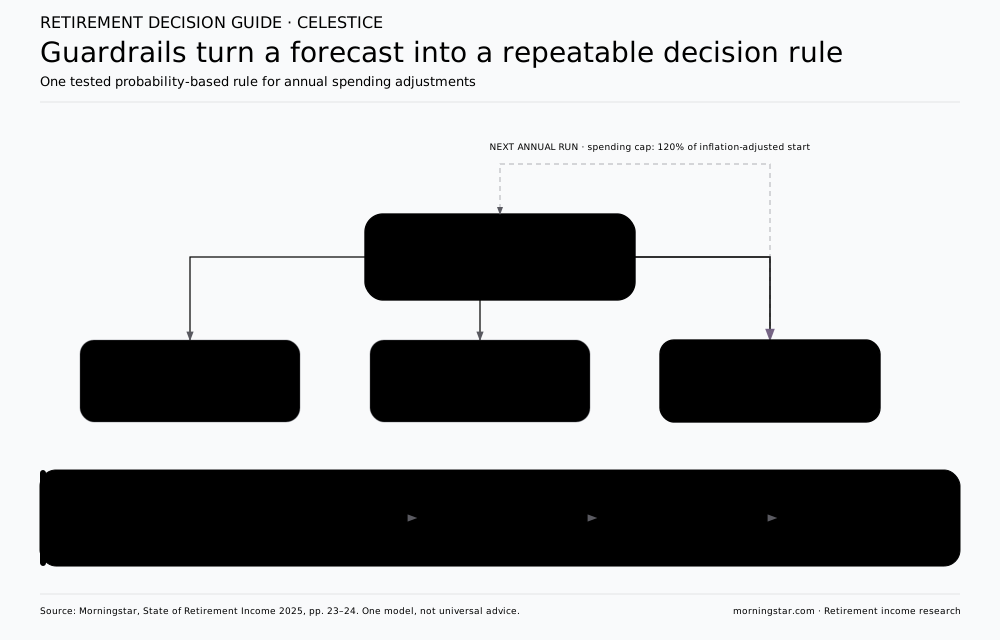
Probability-based guardrails. Re-run the retirement projection at a scheduled review. Morningstar's simplified research example cut spending 10% when estimated success probability reached 75%, raised it 10% at 95%, and capped annual spending at 120% of initial inflation-adjusted spending. This approach uses more of the plan than a single account balance, but results depend heavily on assumptions and software.
Floor-and-ceiling spending. Calculate a portfolio-based withdrawal, then limit the year-over-year change. Morningstar tested a Vanguard-style method allowing no more than a 5% increase or 2.5% decrease from the prior year's withdrawal. This smooths the paycheck but may respond slowly to a severe change.
RMD-style spending and constant-percentage withdrawals are also adaptive because the dollar amount follows the remaining balance. They make portfolio depletion unlikely by construction, yet cash flow can vary sharply and become very low after losses. A statutory RMD is also a tax rule for specified accounts, not evidence that the resulting amount is a safe household budget.
Watch this: A threshold is incomplete without a measurement date, balance definition, adjustment size, spending floor, and rule for exceptional events.
A practical guardrail example
Consider a household with a $1.2 million portfolio. Social Security and pension income cover most essential expenses, leaving a $12,000 annual floor gap. The couple also plans $30,000 of flexible portfolio-funded spending. Their initial $42,000 withdrawal is 3.5% of the portfolio.
For illustration, they set a review band 20% around that initial rate:
- upper guardrail: 4.2%;
- lower guardrail: 2.8%; and
- adjustment: 10% of the scheduled portfolio withdrawal.
After a difficult year, suppose the portfolio is $960,000 and the inflation-adjusted withdrawal would be $43,050. That is about 4.48% of the current balance, above the upper guardrail. A 10% reduction would bring the portfolio withdrawal to about $38,745. The household directs most of the $4,305 cut to flexible plans rather than pretending that every bill is equally negotiable.
After a strong year, suppose the balance is $1.6 million. The same scheduled $43,050 is about 2.69%, below the lower guardrail, so the rule permits—but does not require—a raise. Before accepting it, the couple checks future taxes, reserve levels, long-term care, legacy goals, and whether the market gain merely restored an earlier loss.
This example is intentionally simple. A real calculation should specify whether the balance is measured before or after withdrawals, how inflation is applied, when the test occurs, whether adjustments compound, and how long the rules remain active.
Turn signals into household decisions
Separate a guardrail signal from its funding action
A spending decision answers how much the household may use. A sourcing decision answers where the cash comes from. Combining them carelessly can create avoidable taxes or investment damage.
When a cut is triggered, the next paycheck might still come from operating cash while a bond matures. When a raise is permitted, it may be funded during scheduled rebalancing rather than by selling whichever holding has the highest yield. A written retirement paycheck system keeps these mechanics separate.
Required minimum distributions must remain on the calendar even when a spending guardrail calls for a cut. If an RMD exceeds the amount needed, the after-tax surplus can be reinvested in a taxable account; eligible charitable distributions may be another option. Conversely, a guardrail raise from a traditional account may increase taxable Social Security or future Medicare premiums. Model the gross distribution, tax withholding, and net spending together.
“A guardrail is a promise to revisit the decision, not a promise that markets will cooperate. Its strength comes from small, timely adjustments made by rule.”
Stress-test the rule, not just the portfolio
Before adopting a system, replay it through situations that challenge both the math and the household:
- Stocks and bonds decline together in the first two years.
- Inflation lifts the floor while the portfolio guardrail calls for a cut.
- One spouse dies, reducing income and changing the tax filing status.
- A long-term-care or home expense arrives after several weak years.
- RMDs create taxable income even though spending is reduced.
- Markets surge, trigger raises, and then reverse the following year.
Ask how often adjustments occur, how large the lowest inflation-adjusted paycheck becomes, and whether the couple would follow the rule. A mathematically efficient plan that causes panic or resentment in ordinary conditions is not behaviorally robust.
Use a calm annual decision cadence
Choose one review month and define exceptional triggers, such as a major health event, death, tax-law change, or portfolio movement beyond a stated range. At the meeting:
- update balances, spending, inflation, life expectancy, and income;
- compare actual withdrawals with the floor and flexible budget;
- test the guardrail under consistent assumptions;
- review tax brackets, RMDs, Medicare thresholds, and charitable plans;
- decide whether to cut, hold, or raise—and document why;
- refill cash through maturities and rebalancing; and
- set the next review date before executing changes.
Do not check the rule every trading day. Guardrails are designed to replace improvisation with discipline, not to turn retirement into a market dashboard.
Morningstar's research captures the central trade-off: flexible methods can support more lifetime spending, but generally introduce more cash-flow variation and may leave less for heirs. Fixed real spending offers stability and often a larger median ending balance, but it can encourage underspending and may be vulnerable when the starting amount proves too high. The right design reflects which outcome matters most.
Let Celestice watch the guardrails between decisions
The difficult part is not writing a percentage on a page. It is applying the same rule as balances, spending, income, taxes, and required distributions change—without making the household repeatedly reconstruct the logic from spreadsheets and meeting notes.
Once the household sets its floor, flexible budget, thresholds, and decision boundaries, Celestice carries the routine coordination in the background. It incorporates connected changes, checks the rule, reruns the analysis they affect, and preserves the reasoning behind the current course. Most changes require no interruption. When a threshold is crossed, a raise becomes supportable, or a meaningful exception appears, Celestice shows what changed and brings forward the decision. The household can inspect every input, revise the proposal, and approve or override the response.
The bottom line
No withdrawal framework can promise that money will last forever. A well-designed guardrail does something more credible: it identifies stress early, protects priorities, and creates a measured response while the household still has choices.
Subscribe to keep retirement guardrails working between decisions. Celestice does the continuous checking and coordinated analysis, then brings forward only the cut, hold, or raise decisions worth your attention—with control of the response still in your hands.
Sources and further reading
- Morningstar: The State of Retirement Income: 2025 (dynamic spending, Social Security, TIPS, and annuity analysis)
- J.P. Morgan Asset Management: Guide to Retirement (2026 edition, especially pages 27 and 31–40)
- Kitces: Why a 50% probability of success can be viable with ongoing adjustment
- MarketWatch: Longevity anxiety among boomers and Gen X
- Fisher Investments: Retirement planning resources, including The 15-Minute Retirement Plan and The Definitive Guide to Retirement Income (2025 editions)
- IRS: Required minimum distributions