


Headlines often translate a long-term financing projection into a frightening monthly cut. The underlying issue is real: Social Security’s dedicated trust funds face a projected shortfall if Congress makes no changes. But “shortfall” does not mean the program runs out of all money, and one newspaper dollar estimate is not a personal forecast.
A serious plan does two things at once: it respects the risk and avoids pretending to know the legislation, timing, inflation, earnings record, marital status, or claiming age that will ultimately determine one person’s benefit.
Key takeaways
- Trust-fund depletion does not mean Social Security benefits automatically fall to zero.
- Distinguish OASI from combined OASDI and scheduled benefits from currently projected payable benefits.
- Apply a published percentage to the household's official estimates instead of treating an average-dollar headline as a personal forecast.
- Precommit a response ladder and update it when a Trustees Report or enacted law changes the evidence.
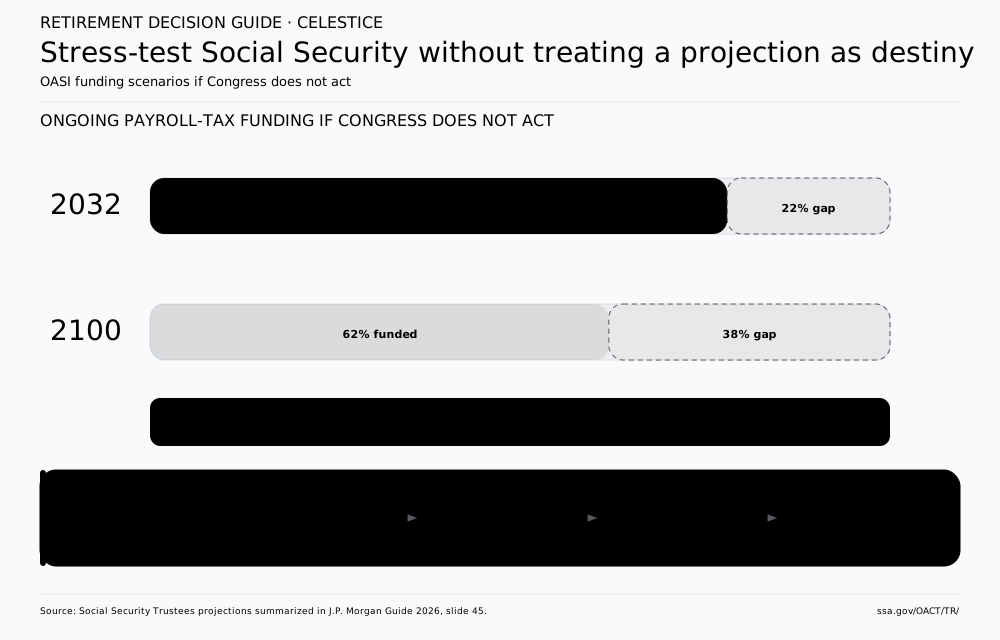
Source: 2026 Social Security Trustees Report, summarized in J.P. Morgan's 2026 guide. These are OASI stress-test projections if Congress does not act, not certain benefit cuts.
Read the official projection correctly
What trust-fund depletion means
Social Security is financed primarily through payroll taxes, with trust-fund reserves covering the gap when current tax income and other income are below scheduled costs. “Depletion” means the reserves for the relevant trust fund are projected to reach zero under the Trustees’ assumptions. Ongoing payroll taxes would still fund a substantial portion of scheduled benefits; benefits would not automatically fall to zero.
The Old-Age and Survivors Insurance trust fund and Disability Insurance trust fund have separate legal accounts, while many headlines cite a combined hypothetical measure. Their dates and payable percentages can differ. Always record which measure a source is using.
J.P. Morgan’s 2026 retirement guide, citing the 2026 Trustees Report, explains the distinction. Under the report’s intermediate assumptions, Old-Age and Survivors Insurance reserves are projected to be depleted in 2032, while the hypothetical combined OASDI measure reaches that point in 2034. The guide estimates that ongoing tax income could cover about 78% of scheduled OASI benefits at the 2032 date and about 83% of scheduled combined OASDI benefits at the 2034 date if law does not change. Use the newest report available when making a decision; every annual projection can move with demographics, wages, inflation, productivity, disability experience, and economic assumptions.
Why a headline dollar cut is not your cut
A statement such as “the average check could fall by $X per month” usually combines:
- a national average or illustrative benefit;
- one Trustees projection and payable percentage;
- a future year expressed in nominal dollars;
- an assumption that current law remains unchanged; and
- no adjustment for a reader’s claiming age, earnings history, spouse, taxes, or COLAs.
That may communicate scale, but it cannot plan a household. A percentage scenario applied to your official estimate is more transparent. Even then, distinguish between a reduction to scheduled future benefits and a cut to the check a retiree receives today.
Congress has many levers—and the combination is unknown
Lawmakers can change revenue, benefits, eligibility, or financing. Frequently discussed options include changing the taxable wage base or payroll-tax rate, adjusting the benefit formula, modifying full retirement age, changing cost-of-living calculations, taxing benefits differently, adding general revenue, or protecting current retirees and lower earners while phasing changes for younger workers.
This is not a forecast or endorsement. It explains why a plan that assumes one immediate, uniform cut for everyone may be as unrealistic as assuming no change ever occurs.
Age matters. People already receiving benefits or close to retirement have less time to adapt and have historically been central to transition discussions. Younger workers have more time to save but more policy uncertainty. Model the household’s age cohort without claiming certainty about future law.
Turn uncertainty into household scenarios
Build three transparent benefit scenarios
Use official estimates for each spouse and write an “as of” date.
Scheduled-benefit case. Current-law scheduled benefits at the intended claiming ages. This remains a valid baseline, not a promise.
Planning haircut. A rounded reduction—perhaps 10%—starting at the modeled depletion year or a selected earlier date. This tests resilience without asserting a legislative outcome.
Trustees payable case. Apply the percentage of scheduled benefits shown in the latest Trustees Report if reserves are depleted and no legislation is enacted. Update annually.
For a younger household, add a reform case with later claiming age or a changed formula. For a retiree, consider whether any change is phased in rather than immediate. State the scenario in plain language: “Beginning in 2032, assume retirement and survivor benefits are 78% of scheduled amounts, then grow with the modeled COLA.” That is the 2026 OASI stress case, not a prediction of future legislation; update it with each Trustees Report. Never hide the assumption inside a generic “income” cell.
Scenario discipline: Label the trust fund, source date, start year, and percentage in plain language. A stress case is useful because it is transparent—not because it predicts Congress.
Measure the right household impact
For each scenario, calculate:
- essential spending covered by Social Security, pension, and other dependable income;
- additional annual portfolio withdrawal;
- effect on the starting and later withdrawal rates;
- result under a poor market sequence near the change date;
- tax effect, because lower benefits can change taxable Social Security;
- survivor income after either spouse dies; and
- which flexible goals would be delayed or reduced.
A $10,000 income reduction is far more consequential when it opens an essential-spending gap than when it reduces an already flexible legacy goal. Rank the exposure by purpose.
Do not claim early only because of a shortfall headline
“Take it before it disappears” sounds intuitive but can be self-defeating. Claiming early locks in a smaller worker benefit under current law. A future legislative change could apply regardless of claim status, protect current beneficiaries, or follow a structure no one can know today. The higher earner’s early claim can also reduce survivor protection.
Run the claiming decision both before and after the shortfall scenario. If delay is attractive for longevity insurance and survivor income in both cases, the headline did not reverse the logic. If the portfolio cannot safely fund the bridge, that cash-flow constraint—not fear—may support a different age.
Precommit the household response
Create a response ladder before it is needed
Assign responses from least disruptive to most consequential:
- Update the official estimate and scenario annually.
- Redirect a portion of raises, bonuses, or catch-up contributions while working.
- Work somewhat longer or phase retirement if health and employment permit.
- Optimize the higher earner’s claiming date and survivor benefit.
- Reduce taxes, fees, and avoidable portfolio leakage.
- Trim or delay flexible spending using pre-agreed guardrails.
- Reconsider a housing cost, major purchase, or legacy target.
- Add appropriate dependable income after evaluating liquidity, inflation, insurer, and legacy trade-offs.
Do not “solve” the shortfall by increasing assumed investment return or taking risk the household cannot tolerate. More risk is not guaranteed income.
“Uncertainty is not a reason to erase Social Security from the plan or count every scheduled dollar as certain. It is a reason to build transparent scenarios and predetermined responses.”
Protect the essential-income floor
Map essential spending against Social Security, pension, and any contractual income. If the stress case creates a gap, decide which assets would fund it. A bond or TIPS ladder can match a defined period of real spending; a cash reserve can bridge shorter gaps; an annuity may transfer longevity risk but reduces liquidity and depends on contract terms and insurer strength.
The investment portfolio still needs growth for a long retirement. Setting aside every future dollar in cash may protect nominal principal while losing purchasing power. Match assets to time horizons and keep a diversified growth allocation for later years.
Coordinate taxes and retirement accounts
A lower benefit can change the amount of Social Security included in taxable income, but the portfolio withdrawals used to replace it may create ordinary income or capital gains. Test the net effect.
Before RMDs, planned traditional-account distributions or Roth conversions may reduce future forced income. Roth assets can later supply cash without increasing federal taxable income when qualification rules are met. Taxable accounts provide basis and tax- lot flexibility. Preserve all three where possible rather than consuming one pool by a rigid rule.
Review cadence and evidence
Each year:
- read the Social Security Trustees Report summary and record its publication date;
- update both spouses’ official estimates and earnings records;
- check whether legislation—not proposals or campaign statements—changed current law;
- rerun scheduled, haircut, and payable scenarios;
- review the survivor case and guardrails; and
- update the decision record before changing a claiming date.
Use SSA.gov for official information. Social Security impersonation scams often use fear, urgent payment demands, threats to suspend a number, or requests for gift cards and cryptocurrency. Verify communications through official channels.
Let Celestice carry the uncertainty between reports
The practical problem is version control. A household may have one benefit estimate in a spreadsheet, a different trust-fund assumption in a planning report, and no record of which spending or saving response was supposed to follow if the stress case occurred.
Celestice keeps the official source date, scheduled and payable cases, household impact, and response ladder together as a living decision context. As connected benefit, policy, or household inputs change, it updates the affected comparison and checks whether the response sequence still protects essential spending. Routine changes remain background work. If the risk crosses a meaningful boundary or a response should move earlier, Celestice brings forward the exception and its evidence. The household can inspect the source, revise the assumption, and approve or override the next step without mistaking a scenario for a forecast.
The bottom line
Social Security uncertainty belongs in the plan, not in the panic cycle. Scheduled benefits remain a useful baseline; an official payable-benefit scenario reveals the risk; and a response ladder turns that risk into manageable choices. The purpose is not to predict Congress. It is to ensure that essential retirement goals do not depend on one unexamined assumption.
Subscribe to move Social Security uncertainty into the background. Celestice keeps the scenarios and response ladder connected, then brings you only the policy change or household decision that materially affects the plan.
Sources and further reading
- Social Security Administration: Trustees Reports
- SSA: 2026 Trustees Report
- Congressional Research Service: Social Security
- SSA: Retirement benefits
- MarketWatch: Projected Social Security benefit reductions
- J.P. Morgan Asset Management: Guide to Retirement 2026
- Morningstar: The State of Retirement Income: 2025