


Social Security may be the closest thing many households have to inflation-adjusted lifetime income. The claiming choice is generally permanent, its rules interact across spouses, and its value cannot be measured by adding checks to one guessed life expectancy.
Use this guide to organize the decision, then verify your personal record and current rules with the Social Security Administration. This is general education, not benefits, tax, or investment advice.
Key takeaways
- Verify both spouses' earnings records and official estimates before comparing claim dates.
- Compare 62, full retirement age, and 70 after taxes and bridge withdrawals—not with a break-even age alone.
- Give the higher earner's delay special attention because it can strengthen the surviving spouse's income floor.
- Recheck the decision after material changes in work, health, marriage, portfolio capacity, or law.
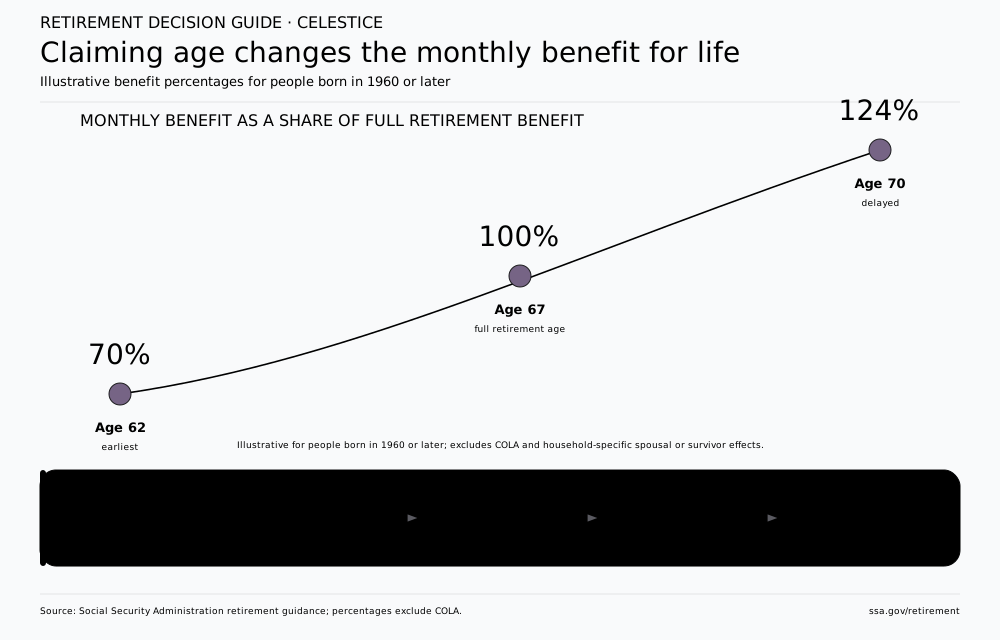
Source: Social Security Administration retirement guidance. Percentages are for people born in 1960 or later and exclude COLAs and household-specific spousal or survivor effects.
Establish the worker benefit
Start with your own record
Create or review your official my Social Security account. Confirm the earnings history year by year and compare estimates at different claiming ages. Retirement benefits generally use the highest 35 years of wage-indexed earnings. Fewer than 35 years can introduce zeros, and continued high-earning years can replace lower ones.
The estimate assumes future earnings. If you plan to stop work earlier than the estimate assumes, model that lower path. Correct earnings-record errors promptly and retain W-2s, tax returns, and other evidence.
Three terms matter:
- Primary insurance amount (PIA): broadly, the benefit payable at full retirement age based on the worker’s record.
- Full retirement age (FRA): between 66 and 67 under current law, depending on birth year; it is 67 for people born in 1960 or later.
- Delayed retirement credits: increases for waiting beyond FRA, generally until age 70. There is no additional retirement-benefit increase for waiting past 70.
What claiming at 62, FRA, or 70 changes
Claiming as early as 62 produces more checks sooner but a permanently smaller monthly worker benefit. Claiming at FRA avoids the early-retirement reduction. Delaying to 70 produces the largest monthly worker benefit under current law and also enlarges the base to which future cost-of-living adjustments are applied.
The exact adjustment depends on birth year and claiming month. Use SSA’s calculators; do not rely on a rounded percentage from an article. Also distinguish retirement age from Medicare age. Medicare eligibility commonly begins at 65, and delaying Social Security does not automatically protect a person from late-enrollment penalties.
Use break-even age as one input, not the answer
A break-even calculation asks when the cumulative value of larger delayed checks catches up with benefits forgone while waiting. It is useful, but incomplete. Results change with taxes, cost-of-living adjustments, investment return on bridge assets, mortality, and spouse or survivor benefits. More importantly, Social Security partly insures against living much longer than expected. A single break-even age assigns no value to that risk transfer.
Compare at least:
- cumulative benefits at several lifespans;
- after-tax household cash flow;
- portfolio withdrawals needed while delaying;
- a poor early-market sequence during the bridge period; and
- the survivor’s income after either spouse dies first.
Morningstar’s 2025 retirement-income research found that delaying Social Security can improve lifetime spending in many modeled cases, especially when paired with a disciplined bridge and adaptive spending. That is a scenario result—not proof that every person should delay.
Health and longevity: plan beyond averages
Poor health and a shorter expected lifespan can support earlier claiming, particularly when cash is needed. Strong health, family longevity, and concern about outliving assets can increase the value of delay. For couples, consider the joint-life horizon: there may be a high probability that at least one spouse lives into their 90s.
Do not make the decision from health alone. A higher earner with reduced longevity may still delay to strengthen the surviving spouse’s benefit. Conversely, a single person with substantial guaranteed income and a strong legacy goal may weigh the trade-off differently.
Coordinate household benefit rules
Work before full retirement age
If you claim before FRA and continue working, the retirement earnings test can temporarily withhold benefits when earned income exceeds the current annual limit. A different, higher limit applies in the year FRA is reached, and the test ends beginning with the month FRA is attained. Pensions, investment income, and many other sources are not “earnings” for this test.
Withheld benefits are not simply lost: SSA adjusts the benefit at FRA to account for months withheld. Still, the cash-flow timing matters. Separately, additional earnings may replace a lower year in the 35-year benefit record.
Spousal benefits: coordinate two records
A spouse may be eligible for a benefit based on the worker’s record. At the spouse’s FRA, the maximum spousal amount is generally up to 50% of the worker’s PIA—not 50% of the worker’s larger age-70 benefit. Claiming the spousal benefit early can reduce it. SSA generally pays the person’s own benefit first and adds any spousal amount needed to reach the eligible combined level; the two full benefits are not stacked.
Under current deemed-filing rules, most people who apply for either a retirement or spousal benefit are treated as applying for both. Older “file and suspend” or restricted- application strategies discussed in legacy articles generally no longer apply to new claimants.
Build a household comparison instead of optimizing each spouse separately. A common pattern worth testing is for the lower earner to claim earlier while the higher earner delays, but employment, age gap, health, portfolio needs, and survivor protection can support other sequences.
Divorced-spouse benefits
A divorced person may qualify on a former spouse’s record under current rules when the marriage lasted at least 10 years, the applicant is generally at least 62 and unmarried, and other eligibility conditions are met. If the former spouse is eligible but has not yet claimed, a two-year divorce-duration rule may allow an independently entitled divorced-spouse benefit.
Claiming on an ex-spouse’s record does not reduce the ex-spouse’s benefit or a current spouse’s benefit. Remarriage and timing can change eligibility. Because rules differ for spousal and survivor benefits, confirm the exact case with SSA.
Survivor benefits may be the most important couple decision
When one spouse dies, two retirement checks generally do not continue. The survivor may receive the larger eligible benefit, subject to claiming-age rules, rather than both. The higher earner’s delay can therefore provide a larger lifetime floor for the survivor.
Survivor benefits can begin as early as age 60 in many cases, or age 50 when disabled, and different rules may allow a person to take one benefit first and switch to another later. A surviving divorced spouse can qualify after a marriage of at least 10 years, subject to current requirements. Remarriage at age 60 or later generally does not end survivor eligibility, while earlier remarriage may.
Also model what changes beyond Social Security: pension income may decline, tax filing status usually becomes single after the year of death, Medicare thresholds narrow, and many household expenses remain.
Household priority: Test the surviving spouse's income floor before choosing the combination that produces the highest individual cumulative benefit.
Family and disability benefits
A worker’s claiming decision can affect benefits for minor or disabled children and, in some cases, a spouse caring for a qualifying child. Family maximum rules can limit total benefits payable on a record. Social Security Disability Insurance has its own eligibility and conversion rules. If these circumstances apply, request a personalized SSA estimate rather than using a standard retirement calculator.
Integrate claiming with portfolio and taxes
Taxes: claiming age and withdrawal strategy interact
Depending on provisional income, up to 85% of Social Security benefits may be included in federal taxable income. That does not mean benefits face an 85% tax rate. The formula uses adjusted gross income, tax-exempt interest, and one-half of benefits with specific adjustments. States vary in their treatment.
Delaying Social Security can create “bridge years” funded from cash, taxable investments, or retirement accounts. Those years may offer room for Roth conversions or planned traditional distributions before RMDs begin. But a conversion, gain, or distribution can affect ACA premium credits before Medicare and Medicare IRMAA two years later. Model the entire return, not just the benefit.
“Social Security is not just an age decision. It is an inflation-aware lifetime-income, survivor-protection, tax, work, health, and portfolio decision for the whole household.”
How to fund the bridge to age 70
If delay is attractive, specify where the missing checks come from:
- wages or part-time work;
- cash reserves;
- high-basis taxable investments;
- a bond or TIPS ladder aligned with bridge years;
- measured traditional-account withdrawals or Roth conversions; or
- a coordinated mix.
Then stress-test a market decline during the bridge. Selling growth assets after a sharp loss can weaken the plan even if the later Social Security benefit is larger. A prebuilt reserve or ladder can reduce that sequence risk, while guardrails can defer flexible spending.
Social Security Fairness Act: update old assumptions
The Social Security Fairness Act, signed in January 2025, repealed the Windfall Elimination Provision and Government Pension Offset for benefits payable after December 2023. Older guides may still show reductions tied to pensions from work not covered by Social Security. People affected should review their SSA record and payment history rather than carrying those old formulas forward. Other eligibility, taxation, and pension rules still apply.
Make and revisit the decision
A practical claiming checklist
- Verify earnings histories and estimates for both spouses.
- Compare 62, FRA, and 70, plus the actual intended month.
- Use realistic future earnings if work will stop or change.
- Model both lifespans and both orders of death.
- Calculate spousal, divorced-spouse, survivor, child, or disability benefits where relevant.
- Add the earnings test, taxes, Medicare timing, IRMAA, and ACA coverage.
- Identify the bridge assets and stress-test a poor early market.
- Compare household after-tax spending and survivor income—not just cumulative checks.
- Recheck the decision after a health, work, marital, or law change.
- Apply several months before the desired start date and verify the first payment.
Let Celestice carry the claiming analysis forward
Claiming becomes difficult when SSA estimates, the survivor budget, tax projections, and bridge assets are evaluated in separate worksheets. A date that looks attractive on a cumulative-benefit chart can put pressure on the portfolio or leave the surviving spouse with a weaker income floor.
After the household sets its priorities and candidate dates, Celestice carries that context forward. It incorporates connected changes, reruns the cash-flow, tax, bridge, and survivor analysis they affect, and checks whether the preferred date still supports the household. It stays out of the way when the conclusion holds. If a material change creates a better option or weakens the plan, Celestice brings forward the evidence and decision while there is still time to act. The household remains free to inspect, change, approve, or override the recommendation.
The bottom line
The strongest claiming decision supports the household’s lifetime income floor while leaving the portfolio, tax plan, and survivor better prepared for uncertainty.
Subscribe to keep the Social Security choice aligned as life changes. Celestice keeps the benefit, bridge, tax, and survivor work coordinated, then asks for your attention only when a changed assumption or claiming choice matters.
Sources and further reading
- Social Security Administration: Retirement benefits
- SSA: Full retirement age
- SSA: Benefits for spouses
- SSA: Survivor benefits
- SSA: Receiving benefits while working
- SSA: Social Security Fairness Act
- J.P. Morgan Asset Management: Guide to Retirement 2026
- Morningstar: The State of Retirement Income: 2025