


“Keep ten years in cash” sounds safe. It may also expose a large share of a retirement portfolio to inflation and repeated reinvestment decisions. “Stay fully invested” sounds efficient. It can become painfully impractical when the next five years of bills depend on selling risk assets during a downturn.
A better design assigns different jobs to different time horizons. Cash handles the next payment. Reserves handle surprises. Bonds can match known dates. Growth assets serve later years and legacy goals. The result is often called a bucket strategy, but the label matters less than the cash-flow map and the rules connecting its parts.
This guide assumes you have already calculated the portfolio's role. If not, start with How Much Do I Need to Retire?, then build the monthly mechanics in Retirement Cash Management. The examples here are educational and do not constitute investment, tax, or legal advice.
Key takeaways
- Size near-term assets from the after-tax gap between spending and dependable income, not from a round number of years.
- Give operating cash, contingency reserves, dated bonds, and growth assets distinct jobs.
- Decide whether a ladder will roll forward or deliberately run off before buying its first rung.
- Test inflation, longevity, taxes, issuer risk, and weak markets against the actual maturity calendar.
Size the near-term funding system
Fund the gap, not the entire lifestyle twice
Begin with annual spending, then subtract dependable income expected in the same year:
portfolio funding need = spending + taxes not already budgeted + planned transfers − dependable income
Social Security, pensions, annuity payments, earned income, and rent may all reduce the gap, but they deserve different confidence and inflation assumptions. Deduct only cash that is reasonably available; do not count a benefit before its start date, gross rent before expenses, or the same dividend in both income and portfolio return.
Next, divide spending into a protected floor and flexible wants. A bond ladder intended to secure housing, food, insurance, and health-care premiums can be sized differently from a travel budget that will respond to markets. This prevents an appealing phrase like “ten-year bucket” from becoming an arbitrary ten times last year's withdrawal.
Give each layer one clear job
A practical structure might contain four connected layers:
| Layer | Typical job | Main risks |
|---|---|---|
| Operating cash | Next several weeks or months of bills | Inflation, excess idle balance |
| Contingency reserve | Spending shocks and timing errors | Opportunity cost, false sense of security |
| Bond or TIPS ladder | Scheduled portfolio gap over selected years | Credit, inflation, interest-rate, liquidity, reinvestment |
| Diversified growth portfolio | Later spending, longevity, and legacy | Market loss, behavioral selling, uncertain returns |
J.P. Morgan's 2026 Guide to Retirement illustrates a near-term bucket holding one to three years of the gap between income and spending, plus a cushion for unexpected expenses, while assets for longer horizons take progressively more investment risk. That is a useful starting concept, not a universal allocation. A larger pension and smaller gap may justify less liquidity; large near-term projects or uncertain health costs may justify more.
Keep the contingency reserve separate from scheduled withdrawals. If next year's property tax and a roof replacement are both labeled “cash,” the plan can accidentally spend one dollar twice.
Choose the ladder building blocks
What a bond ladder actually does
A traditional bond ladder owns individual bonds with staggered maturities. A retiree might hold rungs that mature in 2027, 2028, 2029, and so on. Coupons provide cash along the way; each maturity returns principal, assuming the issuer pays as promised. Matching a rung to a known spending year reduces dependence on the bond's market price on that date because the plan is to hold it to maturity.
This does not make the ladder risk-free. Corporate and municipal issuers can default; callable bonds may repay earlier than planned; inflation can erode nominal payments; and any bond sold before maturity may be worth less after rates rise. A ladder also faces reinvestment risk if proceeds are intended to purchase a new distant rung at an unknown future yield.
Northern Trust's distributing-ladder research frames the problem as goal-relative risk. In its historical illustration, short Treasury bills had little price volatility but a wider range of outcomes against a series of ten annual cash-flow goals because their yields had to be reset repeatedly. High-quality municipal bonds aligned with those dates had much lower dispersion around the goal. The broader lesson is valuable: the “safest” asset cannot be judged apart from the date and amount of the liability.
Nominal bonds, TIPS, and cash solve different problems
Treasury securities carry the federal government's credit backing and can match a known nominal dollar need. Their purchasing power is not protected if inflation turns out higher than expected.
Treasury Inflation-Protected Securities adjust principal with the Consumer Price Index; their coupon is applied to that adjusted principal. A ladder of individual TIPS can therefore target real spending. Market prices still move with real interest rates, and taxable investors can owe federal tax on inflation adjustments before receiving the principal at maturity. Account location and tax cash flow matter.
Municipal bonds may offer federally tax-exempt interest, and sometimes state tax advantages, but carry issuer, call, and market risks. Tax-exempt yield is not automatically superior; compare after-tax yield and credit quality. Holding municipals inside a tax-deferred account generally wastes their core federal tax benefit.
Certificates of deposit and short Treasury bills can be appropriate for nearer dates, subject to insurance limits, liquidity terms, and reinvestment risk. Cash earns its place through access and stability, not because it is the ideal asset for a distant real liability.
Morningstar's 2025 analysis found that, at yields observed on September 30, 2025, a 30-year TIPS ladder supported a 4.5% inflation-adjusted withdrawal rate, versus 3.9% for its highest base-case portfolio rate. That comparison comes with a decisive caveat: the ladder self-liquidates. At year 30 it has no remaining value, while the portfolio approach had a positive balance in 90% of the modeled trials and a substantial median ending balance. A dated ladder protects a horizon; it does not protect against living beyond it.
Individual bonds, ordinary funds, and defined-maturity ETFs
Implementation changes the cash-flow promise.
- Individual bonds offer control over issuer, maturity, and promised principal, but require diversification, trade execution, recordkeeping, and credit monitoring.
- Traditional bond funds diversify and continuously reinvest. Their net asset value and distributions fluctuate, and they do not promise a specific principal payment on a retiree's chosen date.
- Defined-maturity or bullet ETFs hold bonds maturing near a named year and then liquidate. Several funds are normally required to construct multiple rungs.
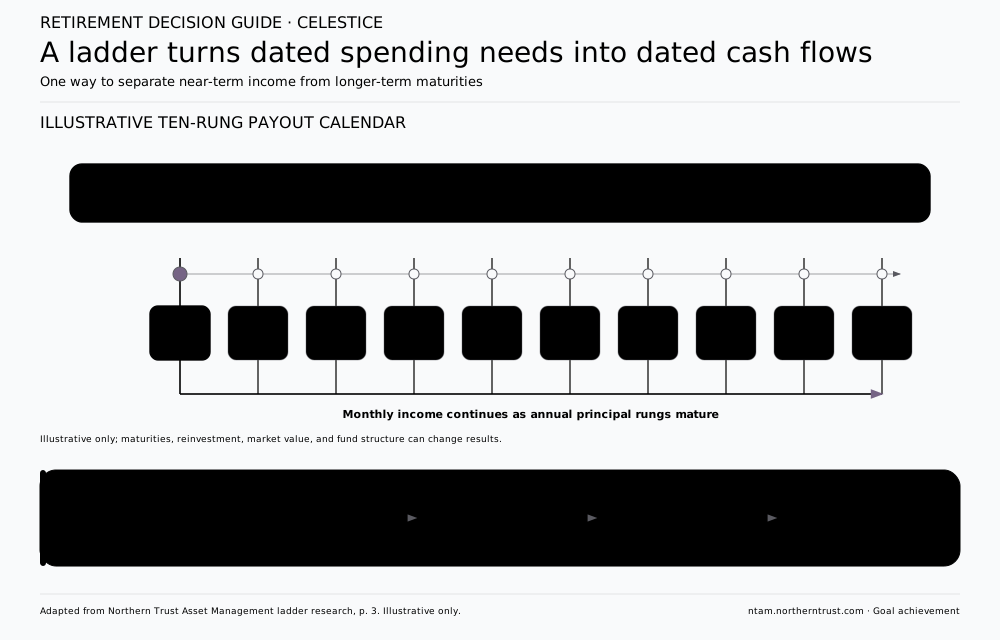
- Distributing-ladder ETFs described by Northern Trust package staggered bonds in a single terminating fund designed to pay monthly income and return portions of principal annually. Unlike an individual bond, however, an ETF has no obligation to return a fixed amount of principal. Distributions, market price, and the split between income and capital can vary; fund, liquidity, premium/discount, and early-termination risks remain.
Read the prospectus and understand whether principal is being preserved, reinvested, or returned. A high distribution is not the same as a high return.
Put the decade on a calendar
A ten-year cash-flow map
Imagine a household spending $108,000 in the coming year. Social Security and pension income cover $66,000, leaving a $42,000 portfolio gap before any additional tax gross-up. Instead of placing $420,000 in a savings account, the household could map:
- operating cash for the next several monthly transfers;
- a distinct reserve for an agreed range of emergencies;
- near-term Treasury bills, CDs, or maturing bonds for the first few annual gaps;
- high-quality nominal or TIPS rungs for selected later years; and
- a diversified growth portfolio for needs beyond the ladder and for contingencies.
The ladder's purchase cost will not simply equal ten times $42,000. Coupons, maturity values, current yields, inflation treatment, taxes, benefit start dates, and changing expenses all affect present value. A delayed Social Security claim, mortgage payoff, or planned travel phase can make the required rungs uneven. Build from a year-by-year calendar rather than ten identical boxes.
Decision rule: Size each rung from that year's expected after-tax portfolio gap—not by multiplying today's withdrawal by the number of years in the ladder.
Decide whether the ladder rolls or runs off
A rolling ladder uses portfolio gains, coupons, and maturing assets to add a new furthest-year rung. A self-liquidating ladder distributes its income and principal over a fixed period and ends. Mixing these intentions creates confusion.
For a rolling design, write replenishment rules such as:
- Review once or twice a year, not after every market move.
- Use coupons and the current rung for scheduled cash flow.
- Refill operating cash to its ceiling, not without limit.
- In a strong market, rebalance appreciated assets and purchase the new distant rung.
- In a weak market, consider delaying the extension, using existing maturities, and trimming flexible spending under the plan's guardrails.
- Restore the target allocation after funding needs rather than treating each bucket as a permanent standalone portfolio.
Buckets can improve behavior by making near-term spending visible. They do not create returns or remove sequence risk by themselves. If the growth bucket is abandoned after a decline, or if every maturity is held as cash indefinitely, the structure can drift away from the strategy it was meant to support.
“The strongest retirement bucket plan is not three disconnected piles. It is one portfolio with a calendar, a purpose for every layer, and rules for moving money between them.”
Coordinate taxes, RMDs, and annuities
Place each rung with after-tax cash flow in mind. IRA maturities can supply required minimum distributions, but the RMD is calculated under tax rules at the account level, not by the ladder's payment schedule. A distribution larger than current spending can be reinvested after tax. Taxable TIPS may create annual taxable inflation adjustments; municipal bonds and Treasury interest receive different federal and state treatment. Coordinate maturities with the annual withdrawal analysis in Retirement Withdrawal Order.
An annuity solves a different problem. A life-contingent annuity can continue paying however long the covered person lives, transferring longevity risk to an insurer. In exchange, the buyer generally gives up liquidity and some legacy value; inflation and survivor protections reduce initial income, and guarantees depend on contract terms and claims-paying ability. A TIPS ladder preserves real purchasing power for a defined period but ends on schedule. Some households combine, rather than choose between, these tools.
Stress-test the next decade before funding it
- Raise inflation for the floor while keeping nominal-bond cash flows unchanged.
- Move a major health or home expense into year two.
- Assume stocks decline just before the first planned ladder extension.
- Test an early death and a life beyond the final rung.
- Reduce a pension survivor benefit or rental income.
- Model an issuer default, bond call, or ETF liquidation before its target year.
- Add tax withholding, RMDs, Medicare thresholds, fees, and transaction costs.
Then check whether the response is operational: which account pays, which asset sells, what spending changes, who approves the action, and when the plan is reviewed again.
Let Celestice keep the maturity calendar synchronized
The operational problem is that future spending, bond maturities, account location, required distributions, and the target allocation often live on separate schedules. A ladder can look complete while a changed benefit date or tax assumption leaves a gap—or while a reserve and a maturity are both assigned to the same expense.
Celestice continuously reconciles each future need with its intended account, rung, tax treatment, reserve, and portfolio role. A changed spending date, benefit, balance, or tax assumption flows through the maturity plan automatically; the AI partner detects a new gap, an overlapping funding source, or a rollover opportunity and prepares the relevant tradeoffs.
Ordinary maturities do not demand household attention. Celestice brings in the household or its professionals when a roll, runoff, refill, or policy exception deserves a decision, preserving the evidence and approval behind the choice. Every assumption and proposed response remains available to inspect, change, approve, or override.
The bottom line
Cash reserves, ladders, and buckets are most useful when they replace improvisation with purpose. Secure the near term without abandoning the long term, match assets to dated needs, and keep enough flexibility for a retirement that will never unfold exactly as a spreadsheet predicts.
Let Celestice keep the next decade aligned. Its AI partner carries the maturity and reserve work forward as conditions change, then brings you in when a rollover, runoff, or refill choice can improve the plan.
Sources and further reading
- Northern Trust Asset Management: Cash Flow Management for the Critical Financial Goals
- Northern Trust Asset Management: Distributing Ladder ETFs—An Innovative Solution for Goal Achievement and its accompanying deep-dive research
- Morningstar: The State of Retirement Income: 2025 (especially the TIPS and annuity analysis)
- J.P. Morgan Asset Management: Guide to Retirement (2026 edition, especially pages 23, 27–42)
- U.S. Treasury: Treasury Inflation-Protected Securities
- Investor.gov: Bonds and fixed-income products
- Fisher Investments: Retirement planning resources, including The 15-Minute Retirement Plan and The Definitive Guide to Retirement Income (2025 editions)
- IRS Publication 550: Investment income and expenses
- IRS: Required minimum distributions