


A retirement plan is a set of assumptions about a life that keeps changing. Markets move, spending surprises, tax rules adjust, health evolves, family needs emerge, and a goal that mattered last year may no longer deserve the same priority. The annual review is the maintenance cycle that reconnects all of those changes.
Schedule 60–90 minutes. Gather the prior plan, latest account and benefit statements, year-to-date spending, tax return, insurance summaries, estate documents, and a list of changes. Use this checklist for a household discussion and as preparation for financial, tax, insurance, or legal professionals.
Key takeaways
- Begin with changes in life and actual spending before reviewing investment performance.
- Reconcile income, reserves, withdrawals, taxes, health care, housing, and protection as one household system.
- Test named setbacks and agree on the first response while choices are still available.
- End with an owner, deadline, and evidence for every material next action.
Reconcile life, spending, and income
1. Begin with life, not the portfolio
Ask what changed since the last review:
- retirement date, work status, or business plans;
- health, mobility, caregiving, or family circumstances;
- marriage, divorce, birth, death, inheritance, or gifts;
- home, location, travel, education, charity, or legacy goals;
- income, debt, insurance, or expected large expenses; and
- comfort with market risk and spending flexibility.
Re-rank goals as essential, important, or aspirational. Mark amount, date, owner, and priority. A retirement model should not quietly keep funding a stale goal while a new care need or housing decision remains outside it.
Also review purpose and well-being. J.P. Morgan’s retirement research highlights social connection, health, and meaning alongside financial preparation. Work, volunteering, learning, family, and community can shape both spending and the quality of retirement.
2. Reconcile actual spending
Compare the last 12 months with planned floor, target, and one-time spending. Explain material differences rather than simply replacing the forecast with the latest total.
- Was a large expense recurring or temporary?
- Did travel, health care, housing, gifts, insurance, or taxes change structurally?
- Were irregular repairs and replacements included?
- Did inflation affect categories differently?
- Which spending could adjust after a poor market, and which could not?
Update the next 24 months monthly and later years annually. Retirement spending can be volatile even if the long-term trend changes with age. A plan needs room for both facts.
Check the budget after the first spouse’s death, too. Some expenses fall, but they may not fall in direct proportion to household size; taxes and Medicare premiums may become less favorable for a single filer.
3. Refresh the income calendar
For every income source, verify amount, owner, start date, inflation feature, survivor treatment, tax character, and current documentation.
Review Social Security statements and claiming assumptions for both spouses. Compare early, full-retirement-age, and age-70 cases with longevity, work, taxes, portfolio bridging, spousal, divorced-spouse, and survivor benefits. Current workers should also verify their earnings record. Medicare timing must be coordinated separately.
For pensions, confirm the plan’s financial health and election options, including single-life versus survivor annuity, lump sum, cost-of-living adjustment, early-retirement reduction, and beneficiary treatment. Once an election begins it may be irrevocable.
Update annuity statements, rental or business assumptions, work income, and any source that is variable or concentrated. Label confidence rather than treating every estimate as guaranteed.
4. Measure cash, withdrawals, and reserves
Reconcile how much the portfolio actually supplied after tax. Calculate the current withdrawal rate using investable assets and distinguish essential from flexible spending. Compare the result with the plan’s horizon, allocation, fees, taxes, and guardrails—not with a rule of thumb in isolation.
Review:
- operating cash for regular bills;
- emergency reserves for spending or income shocks;
- funds earmarked for known purchases;
- the next bond or TIPS maturities;
- the reserve replenishment rule; and
- any credit line, its cost, and its intended role.
If markets declined, document whether guardrails were triggered: defer a flexible goal, pause an inflation increase, rebalance, or spend from planned maturities. If results were strong, decide whether to replenish reserves, fund goals, give, or preserve the surplus. Avoid changing the policy simply because the most recent market move feels permanent.
Re-test the financial plan
5. Review the household portfolio as one system
Aggregate every account. Compare actual asset allocation with target ranges and the cash- flow plan. Identify drift, concentration, illiquidity, credit risk, duration, foreign currency exposure, private investments, and assets that are difficult for a surviving spouse to manage.
Evaluate performance against appropriate benchmarks and the role each holding was meant to serve. Review fees, fund expenses, advisory charges, trading costs, surrender charges, and tax cost. Performance alone is incomplete: a strategy that funded withdrawals, controlled risk, and preserved flexibility may have done its job even if it lagged the hottest market segment.
Check asset location across taxable, traditional, Roth, and HSA accounts. Rebalance with new cash, withdrawals, maturing bonds, and tax lots before creating unnecessary gains. Review concentrated employer stock and inherited assets with their special tax rules.
6. Re-run the plan and named stress tests
Update balances, spending, income, inflation, longevity, and capital-market assumptions. Run a range of returns rather than one average. Monte Carlo results should show a distribution, not a guarantee, and should be paired with historical or custom scenarios.
At minimum test:
- a severe decline in the next two years;
- higher inflation and health-care costs;
- retirement or work ending earlier;
- one spouse living to 100;
- long-term care or a major home expense;
- reduced Social Security benefits after the projected trust-fund depletion date;
- the first spouse’s death; and
- a goal 10% more expensive than expected.
For every weak result, record the response and decision date. The output should not be “worry more”; it should be a ranked set of levers.
7. Build the tax plan before year-end
Project the full federal and state returns. Include ordinary income, taxable Social Security, pensions, RMDs, dividends, interest, capital gains, deductions, credits, net investment income tax, and state-specific retirement rules.
Review:
- RMD status by account, including inherited accounts;
- qualified charitable distributions and gifts of appreciated assets;
- realized gains, losses, tax lots, and carryforwards;
- potential Roth conversions or planned traditional withdrawals;
- Medicare IRMAA using the two-year lookback;
- ACA marketplace income if not yet on Medicare;
- estimated payments and withholding; and
- the surviving spouse’s future filing status and brackets.
Compare multiyear outcomes. Minimizing this year’s bill can enlarge future RMDs or leave the survivor with less flexibility. Coordinate trades and distributions with the portfolio plan, and verify current law before execution.
Protect the household and its continuity
8. Review health care and long-term care
For Medicare, review Part B and Part D or Medicare Advantage coverage, Medigap where applicable, premiums, IRMAA, deductibles, maximum out-of-pocket exposure, provider networks, prescriptions, travel coverage, and enrollment dates. Plans and formularies can change annually.
Update the long-term-care plan:
- preferred setting and location;
- family members willing and able to help;
- home accessibility and transportation;
- estimated cost and duration;
- insurance benefits, exclusions, inflation riders, and claim process;
- assets earmarked to self-fund; and
- legal documents and contacts.
Medicare generally does not cover ongoing custodial care. Medicaid has eligibility and lookback rules that require specialized advice. Treat care planning as a family, housing, legal, and funding decision—not merely an insurance purchase.
9. Revisit housing and debt
Housing is often the largest expense and asset. Ask whether the current home still works for mobility, maintenance, climate, taxes, insurance, transportation, care, community, and proximity to family. Compare staying, modifying, downsizing, renting, relocating, senior housing, and continuing-care options using full costs and quality-of-life goals.
Review mortgages, home equity lines, credit cards, auto debt, and other liabilities. Compare interest cost, liquidity, taxes, investment risk, and peace of mind. Paying debt is not automatically superior to preserving liquidity, and carrying a mortgage is not automatically superior to using investments; model both paths.
10. Check insurance and risk transfer
For every policy, name the risk it protects and the person who depends on it. Review life, long-term care, umbrella, homeowners or renters, auto, health, and any business coverage. Confirm premiums, benefits, beneficiaries, exclusions, riders, insurer strength, and renewal dates.
Do not keep a product merely because it was purchased long ago. Do not cancel one before understanding replacement availability, tax consequences, surrender charges, insurability, and the risk that would return to the household.
“The annual review is where a retirement projection becomes a living plan: actual experience replaces old assumptions, and every important change receives an owner and a next action.”
11. Update estate, incapacity, and legacy instructions
Confirm wills, revocable trusts where used, durable financial powers of attorney, health-care directives, HIPAA authorizations, guardians or care instructions, and final wishes. Review account titles and beneficiary designations—including contingent beneficiaries—because those forms can override a will.
Check the tax and distribution consequences for inherited traditional, Roth, HSA, annuity, business, and taxable assets. Review charitable gifts and family support for fairness, control, and liquidity. Ensure the executor, agent, or trustee knows where the documents are and whom to contact.
12. Strengthen operational and fraud resilience
Retirement security includes the ability to access and protect the plan.
- Maintain an account inventory without storing passwords in an insecure document.
- Use unique passwords, a password manager, and multifactor authentication.
- Add trusted contacts where appropriate; understand that a trusted contact does not automatically gain transaction authority.
- Turn on account and credit alerts and review credit reports.
- Confirm backup access for a spouse or authorized agent through proper legal channels.
- Establish a family verification phrase or callback process for urgent money requests.
- Freeze credit when appropriate and know how to lift it.
Scams increasingly impersonate family, financial institutions, government agencies, and professionals. Slow down urgent requests and verify through a known channel.
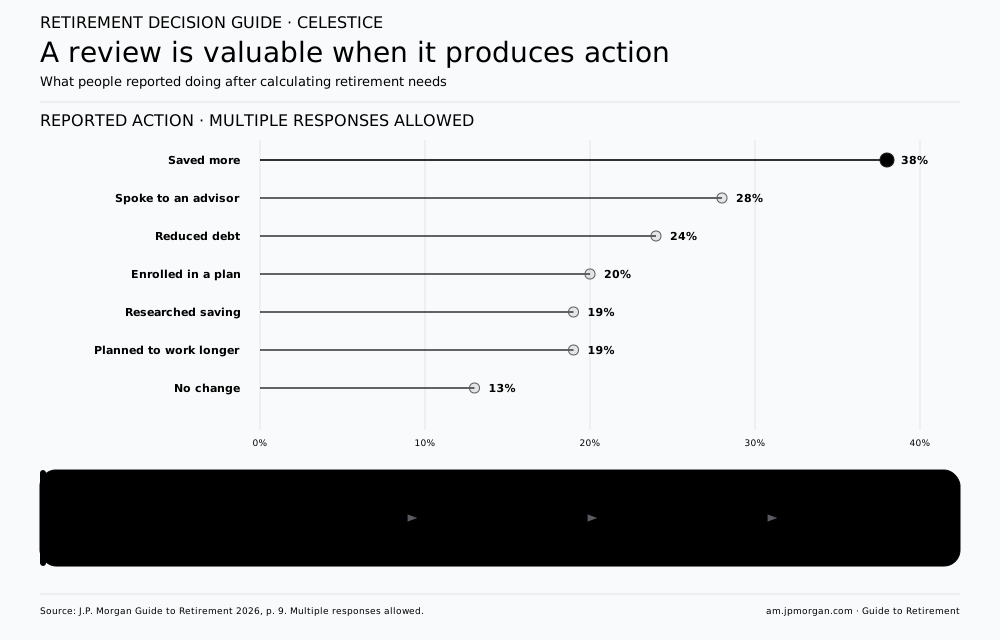
Finish with a one-page decision record
The annual review should produce:
- updated goals and assumptions with an “as of” date;
- current spending, income gap, withdrawal rate, reserve, and allocation;
- selected Social Security and pension cases still under review;
- base, upside, and stress results with agreed guardrails;
- tax, Medicare, housing, care, insurance, and estate actions;
- each action’s owner, deadline, approver, and evidence; and
- the next scheduled review plus event-driven triggers.
Decision rule: A material change without an owner, deadline, and required evidence is still an observation—not an updated retirement plan.
Archive the prior version. The history explains why a decision was made and reveals whether assumptions repeatedly miss in the same direction.
Let Celestice run the review between reviews
The practical problem is not a shortage of statements or projections. It is the long gap between formal reviews, when a tax change, spending shift, market move, or health decision can quietly make several connected assumptions stale.
Once the household sets its priorities and guardrails, the background review becomes the default. Celestice reconciles new connected facts with the existing scenarios and carries the earlier rationale forward. If nothing meaningful moves, nothing asks for attention. When an exception does, it explains what changed, why it matters, and which response deserves a decision. The person can open the analysis, alter an input, approve the next step, or override it with professional input when useful.
The bottom line
An annual review is successful when the household leaves with a clearer plan and fewer unowned risks—not when every forecast is made to look certain.
Subscribe to replace the once-a-year catch-up with an always-on financial partner. Celestice handles the quiet review work; you retain the final say whenever a real decision surfaces.
Sources and further reading
- J.P. Morgan Asset Management: Guide to Retirement 2026 and On the Bench 2026
- Morningstar: The State of Retirement Income: 2025
- Fisher Investments: Retirement planning resources, including The Investor’s Guide to a Comfortable Retirement and The Definitive Guide to Retirement Income (2025)
- Social Security Administration: Retirement benefits
- Medicare: Yearly Medicare plan review
- IRS: Seniors and retirees
- FINRA: Securities Helpline for Seniors
- Consumer Financial Protection Bureau: Planning for retirement