


Retirement planning often excels at preventing failure and says too little about using money well. A household may have a careful withdrawal rate and still postpone a meaningful trip until health makes it difficult. Another may spend enthusiastically in the first year without seeing that several large goals all draw from the same portfolio.
A bucket list resolves neither problem by itself. It becomes useful when wishes acquire priorities, dates, honest costs, funding sources, and rules for change. The objective is not to maximize experiences at any cost or to protect the highest possible ending balance. It is to fund a meaningful retirement while keeping the non-negotiable parts of life secure.
Key takeaways
- Protect essential spending, emergency liquidity, and care funding before committing to large discretionary goals.
- Rank each goal by meaning and time sensitivity, then estimate its complete after-tax cost.
- Match the funding source to the date instead of exposing a near-term experience to an avoidable forced sale.
- Decide in advance when to proceed, resize, defer, accelerate, or replace a flexible goal.
Turn aspirations into a funded plan
Build the floor before the fun budget
Begin with an after-tax essential-spending floor. Include housing, food, utilities, transportation, insurance, taxes, baseline health care, debt payments, and support that the household has committed to provide. Model the survivor household separately: many bills do not fall by half when one spouse dies, while tax filing and some income can change.
Next, set aside distinct reserves for:
- ordinary cash flow and an emergency or spending shock;
- known repairs, vehicle replacement, deductibles, and other lumpy expenses;
- near-term health and accessibility needs; and
- a plausible long-term-care strategy, whether funded by insurance, assets, family support, home equity, or a combination.
Medicare generally does not cover most ongoing long-term care. J.P. Morgan's 2026 retirement framework also emphasizes access to savings and flexibility, not only the amount of income a portfolio may produce. A vacation fund that doubles as the only care or roof-replacement reserve is not truly available for vacation.
Turn wishes into decision-ready goals
Creative Planning recommends beginning early, identifying what matters, and making goals actionable and measurable. A useful inventory goes one step further. Give every item six fields:
- Purpose: Why does this matter—adventure, family, learning, service, health, or legacy?
- Window: Is there a health, season, age, or family reason to do it soon?
- All-in cost: What will it cost after tax, including preparation and follow-through?
- Priority: Is it defining, meaningful, or simply nice to have?
- Flexibility: Can the date, scope, destination, or format change?
- Owner: Who will research, book, monitor, and decide?
This prevents a familiar failure: five individually affordable ideas becoming one collectively unaffordable plan.
Use a priority ladder, not one undifferentiated list
Sort goals into three tiers:
- Defining experiences express the household's deepest priorities and may be time sensitive: a family reunion while everyone can travel, a pilgrimage, or completing a long-held creative project.
- Meaningful goals matter, but their timing or scale can flex: a major trip every other year, regular gifts to grandchildren, or an extended course of study.
- Bonus goals are attractive only when resources and conditions cooperate: a luxury upgrade, another property, or a spontaneous high-cost experience.
Priority is not the same as price. A modest annual trip with siblings may outrank a costly second home. Nor is the list permanent. Revisit it when health, caregiving, relationships, or curiosity change.
Then consider time sensitivity. The Bank of America housing guide describes an active retirement phase, a downshift phase, and a later phase with greater care needs. These are not fixed ages, but the framework is useful: physically demanding travel may deserve an earlier window, while local learning, mentoring, and family traditions can continue as mobility changes. Front-loading a valued experience can be rational when the essential floor remains protected.
Estimate the real cost
Bucket-list budgets often include the headline and omit the edges. For travel, add insurance, ground transport, meals, tips, mobility assistance, currency changes, and a contingency for rebooking. For a second home or recreational vehicle, add closing or dealer costs, tax, insurance, HOA or storage fees, maintenance, travel to the asset, and the cost of eventually selling it. For family gifts, specify whether the amount is one-time or recurring and whether it competes with education, care, or legacy plans.
Express the goal in future dollars if it is years away. Then calculate the gross amount that must leave each account to deliver the desired spendable cash. A $25,000 trip funded from a pretax IRA may require more than a $25,000 distribution; appreciated taxable assets may create capital gains; qualified Roth funds may be tax-free but surrender future tax-free growth. The funding source is part of the price.
Match the funding source to the date
J.P. Morgan's bucket framework aligns portfolio risk with time. Its 2026 guide suggests that a near-term segment may hold one to three years of the gap between income and spending, plus a cushion for unexpected expenses. Longer-horizon assets can then pursue growth without being treated as next year's travel wallet.
For bucket-list goals, use the same logic:
- Within three years: favor cash and high-quality short-term holdings sized to the known expense. The objective is availability, not maximum return.
- Roughly three to ten years: use a diversified mix consistent with the date and the goal's flexibility. Reduce risk as the spending window approaches.
- More than ten years: the goal may share in long-term growth, but it still needs a path for gradually becoming liquid.
These ranges are planning labels, not universal allocations. Coordinate them with the household's total portfolio rather than creating disconnected accounts that accidentally duplicate cash or risk.
Also match dependable income to recurring essentials where practical. Social Security, pensions, and other reliable sources can reduce the amount that must be sold each month. The remaining portfolio can support variable spending, but it still needs tax-aware withdrawal rules.
Keep the plan resilient as life changes
Sequence risk: make flexibility an asset
J.P. Morgan illustrates why withdrawal timing matters: the same average return can lead to very different retirement outcomes when poor markets arrive early and withdrawals remove capital before it recovers. Bucket-list spending is especially suitable for guardrails because much of it can change without threatening housing or food.
Write the rules before markets become emotional. For example:
- Proceed when the essential reserve is full, the goal is funded, and the updated plan remains above its agreed resilience threshold.
- Resize by choosing a shorter trip, economy fare, rental instead of purchase, or a nearby version when costs rise.
- Defer a flexible goal after a severe portfolio decline, large care expense, or loss of recurring income.
- Accelerate a time-sensitive goal when health and family availability matter more than waiting, provided the protected floor still passes stress tests.
- Replace a goal that no longer reflects the household's values rather than spending merely because it was once on the list.
Decision rule: Do not commit money to a flexible goal unless the essential floor, separate reserves, tax cost, and weak-market scenario still pass after the purchase.
This is not punishment after a bad year. Flexibility has economic value: it allows the portfolio to avoid selling depressed assets and lets higher-priority goals remain intact.
An illustrative household
Consider a retired couple whose dependable after-tax income covers most essential costs. Their portfolio must fund an $18,000 annual essential gap, and they keep that gap plus an emergency cushion in near-term reserves. Their list includes a $36,000 family heritage trip in two years, $12,000 of annual travel, and a $90,000 recreational vehicle.
Treating all three as "retirement lifestyle" hides the conflict. Instead, they rank the heritage trip as defining and time sensitive, annual travel as meaningful and flexible, and the vehicle as a bonus. They fund the first trip gradually from cash flow and selected taxable assets, keep the essential reserve separate, and model the vehicle purchase under normal and weak-market scenarios. If the vehicle weakens care funding or requires a large pretax distribution in one year, they can rent one for several trips and revisit ownership later.
The value of the exercise is not the specific answer. It is that an emotional debate becomes a set of visible choices: do the high-value experience, preserve the floor, and retain a lower-cost way to test the bonus goal.
“A good bucket-list plan protects tomorrow without indefinitely postponing today: secure the floor, fund the experiences, and pre-decide what can flex.”
Do not mistake average spending for your plan
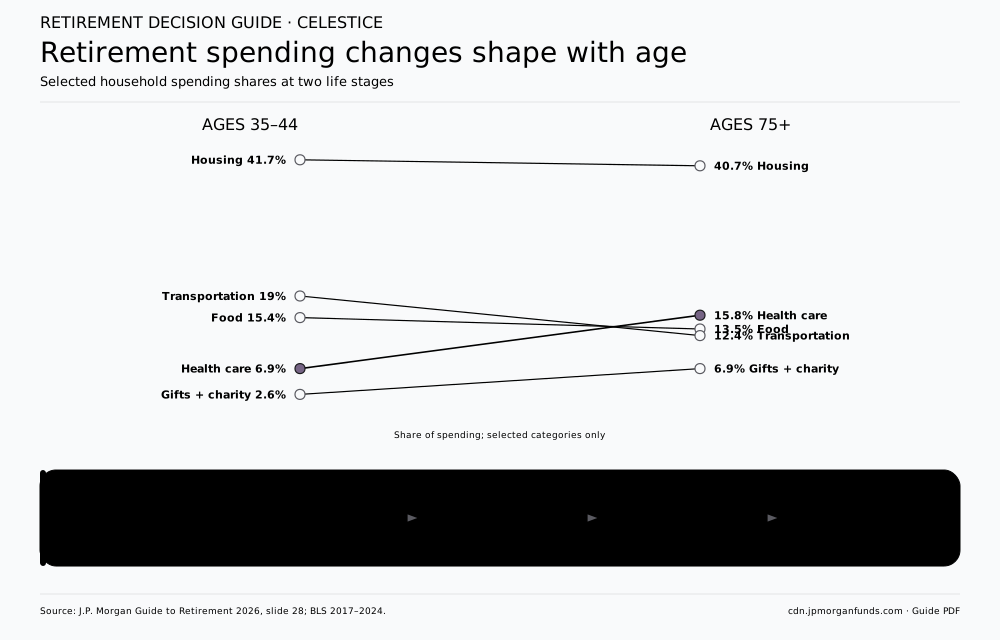
Retirement spending often declines with age on average, particularly for travel and transportation, but averages conceal wide variation. In J.P. Morgan's selected, anonymized household data, 63% of new retirees experienced spending changes greater than 20% during the first three years of retirement, and 54% of households ages 75 to 80 had similar year-to-year volatility. The samples and definitions matter, but the planning lesson is durable: a smooth inflation-adjusted line is not a cash-flow calendar.
Build annual room for one-time spending and model late-life housing and care separately. Do not finance an early-retirement wish by assuming future health costs will simply replace travel dollar for dollar.
Watch the tax and Medicare calendar
Large goals can create avoidable bunching. Before taking a distribution, estimate ordinary income, capital gains, state taxes, Social Security taxation, required minimum distributions, and Medicare's income-related Part B and Part D adjustments. Medicare generally looks back two years for the income measure it uses, so a single large withdrawal can have a delayed premium effect.
Compare funding the goal in one year with saving over several years, selling selected tax lots, or scheduling it in a naturally lower-income period. Tax efficiency should improve the goal, not overrule it: postponing a defining experience solely to minimize a bracket can be a poor life decision. The objective is to see the cost before choosing.
A pre-booking checklist
Before committing money, confirm:
- the essential floor and survivor plan still work under a long life and weak returns;
- emergency, home-repair, and care reserves remain distinct and accessible;
- the goal's all-in cost, deadline, cancellation terms, and contingency are documented;
- the payment source and its federal, state, and Medicare effects have been reviewed;
- travel medical coverage, accessibility, passports, and trusted contacts are ready;
- family members agree on shared costs, responsibilities, and gifts;
- debt used for a discretionary goal has a repayment source that does not depend on strong markets; and
- a less costly substitute is named in advance.
Review the list at least annually and after a major market, health, housing, or family change. Record what was completed and whether it delivered what the household valued. That feedback can improve the next decision more than another decimal place in a forecast.
Let Celestice keep the bucket list fundable
The hard part is not recording a wish. It is seeing when several individually reasonable goals compete for the same reserve, tax year, or pool of investments. That conflict often stays hidden when travel plans, care assumptions, and portfolio projections live in different files.
Once the household defines each goal's purpose, timing, priority, and flexibility, there is no recurring goal-upkeep chore. Celestice recalculates only the goals touched by connected spending, tax, reserve, or portfolio changes. If a trip becomes easier to fund, two goals collide, or a choice would cross a guardrail, it presents the relevant timing, scope, and funding alternatives. The household can inspect the assumptions, select or reshape an alternative, or override the recommendation entirely.
This article is educational and is not individualized investment, tax, legal, insurance, travel, or health advice. Assumptions and rules change; consult qualified professionals for your circumstances.
The bottom line
A retirement bucket list should be neither a guilt list nor a blank check. Protect what must endure, fund what matters most, and give everything else permission to flex. That is how a plan converts savings into a life without asking essential security to bear every risk.
Subscribe to let the bucket list run on clear guardrails. Celestice works quietly in the background and asks only when timing, funding, or approval calls for your judgment.
Sources and further reading
- J.P. Morgan Asset Management: Guide to Retirement 2026
- Bank of America: Housing in Retirement—Your Life, Your Choice
- Creative Planning: Building a Bucket List
- Consumer Financial Protection Bureau: Planning for retirement
- Medicare: Medicare costs
- Medicare: Long-term care coverage
- SSA: Medicare premiums and higher income
- IRS: Retirement plans and IRA required minimum distributions