


Tax returns look backward. Retirement tax planning must look forward. By the time a return is prepared, a Roth conversion cannot be retroactively undone, a missed qualified charitable distribution cannot be repaired by relabeling a check, and a year-end RMD deadline may already have passed.
A calendar solves a practical problem: it gives every decision a review date, an owner, and evidence. Use this guide as a planning framework and confirm current thresholds, eligibility, and deadlines with qualified tax and financial professionals.
Key takeaways
- Track the current-year tax clock and the two-year Medicare income clock together.
- Reforecast after tax documents arrive, at midyear, before benefit elections, and well before year-end processing deadlines.
- Coordinate RMDs, QCDs, Roth conversions, gains, withholding, and health-insurance income instead of evaluating each action alone.
- Record completion evidence; deciding on a transaction is not the same as executing it.
Set the planning clocks
The two clocks every retiree should track
The current-year tax clock controls income, deductions, gains, RMDs, conversions, charitable gifts, and payments reported on this year’s return.
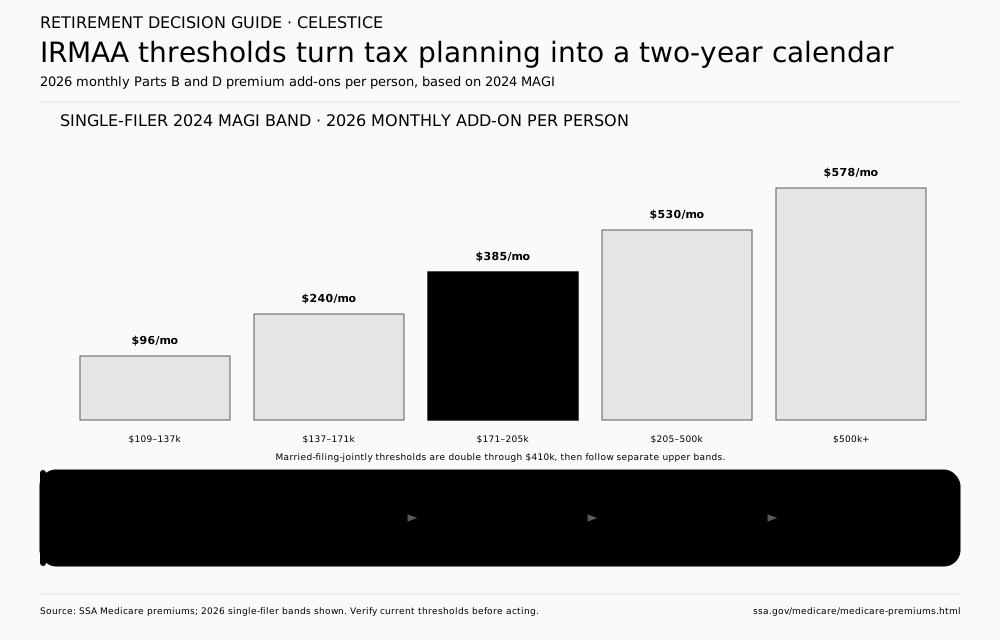
The two-year Medicare clock generally connects this year’s modified adjusted gross income to Medicare Part B and Part D premiums two years later. A 2026 conversion, gain, or business sale may therefore affect 2028 premiums. A life-changing event can support an IRMAA appeal in qualifying circumstances, but thoughtful advance modeling is the first line of planning.
Households retiring before 65 may have a third clock: marketplace health-insurance premium tax credits are based on household income under ACA rules. A conversion or gain can change the subsidy in the same year.
Work the calendar before deadlines
January and February: build the opening ledger
Start with facts rather than estimates.
- Record December 31 balances for every IRA and employer plan that may produce an RMD.
- Confirm whether an account is owned, inherited, traditional, Roth, or part of a current employer plan; the rules are not interchangeable.
- Gather Forms W-2, 1099, SSA-1099, 1099-R, 1099-B, K-1, mortgage and charitable records, and HSA forms as they arrive.
- Reconcile estimated payments and withholding against bank and brokerage records.
- Update cost basis, after-tax IRA basis on Form 8606, capital-loss carryforwards, and receipts for qualified medical expenses paid outside an HSA.
- Estimate fixed income for the new year: Social Security, pensions, annuities, interest, rent, work, and dividends.
If an RMD applies, calculate it account by account. Traditional IRA RMDs can generally be aggregated and taken from one or more traditional IRAs; employer-plan RMD aggregation is more restricted. Inherited accounts and employer plans require particular care. Do not assume a custodian’s display captures every account or beneficiary rule.
March and April: file, learn, and set payments
Use the completed return as a diagnostic:
- Which ordinary-income and long-term-capital-gain bands were used?
- How much of Social Security became taxable?
- Did withholding and estimated payments align with the final liability?
- Were tax-exempt interest, net investment income tax, or state adjustments material?
- What deductions or credits were lost as income rose?
- Which one-time items will not repeat this year?
Then set a payment plan. Federal estimated taxes generally follow four due dates rather than equal calendar quarters. Safe-harbor rules may help avoid underpayment penalties, but a safe harbor does not guarantee the final balance due will be comfortable. Pension, Social Security, IRA, and employer-plan withholding can offer alternatives to quarterly payments; withholding is generally treated as paid evenly through the year for federal penalty purposes, which can be useful when circumstances change late in the year.
Review the prior return for any Roth conversion, nondeductible IRA contribution, QCD, rollover, or inherited-account reporting that needs a consistent record this year.
May and June: model the first-half reality
By midyear, replace budget guesses with actual results. Update wages, consulting income, interest, dividends, capital gains, distributions, and spending. Reforecast the full tax return and test at least three cases:
- No optional action: required and expected income only.
- Planned action: proposed conversion, gain realization, gift, or large purchase.
- Stress case: larger distributions, market losses, health costs, or a filing-status change.
This is the time to identify bracket room and threshold cliffs. Test ordinary-income brackets, long-term capital gains, taxable Social Security, net investment income tax, Medicare IRMAA, ACA credits, state taxes, and any income-linked deductions or benefits.
If estimated income has moved materially, adjust payments or withholding. If charitable giving is part of the plan, confirm which assets and organizations are eligible before initiating transfers.
July and August: coordinate retirement income and health coverage
Summer is a useful planning window because there is enough actual data to improve the projection and enough year remaining to execute carefully.
Review Social Security and pension elections, especially if either spouse expects to claim soon. Confirm Medicare enrollment windows and whether current employer coverage allows delayed Part B without penalty. Estimate future Medicare income-related premiums using the correct two-year lookback and filing status.
For a household not yet on Medicare, model ACA marketplace income before scheduling a conversion or gain. Health-insurance effects can be more consequential than the income tax alone.
If a Roth conversion is under consideration, answer four questions:
- How much taxable income already exists?
- Which assets would be converted, and how would that change risk and allocation?
- Where will the tax payment come from?
- Does the multiyear result improve after future RMDs, survivor taxes, Medicare or ACA, state taxes, and legacy goals are included?
Conversions are generally taxable in the year completed and cannot be recharacterized back to traditional IRA status under current law. Execute measured amounts and leave time for custodian processing.
September and October: lock the action list
Do not wait for the final trading day of December. By early fall:
- Recalculate projected RMD completion across all relevant accounts.
- Decide whether eligible charitable giving will use a QCD, appreciated securities, cash, a donor-advised fund, or a combination.
- Review realized gains and losses by tax lot, including capital-loss carryforwards.
- Evaluate tax-loss harvesting without violating wash-sale rules across the household’s accounts.
- Review concentrated positions and diversification needs; tax deferral is not a reason to retain uncompensated risk indefinitely.
- Confirm planned Roth conversion and traditional withdrawal amounts.
- Review charitable substantiation and appraisal requirements for noncash gifts.
- Begin any complex beneficiary, trust, estate, or business-sale coordination early.
Open enrollment also brings decisions. Medicare plans can change premiums, networks, formularies, and out-of-pocket exposure. Employer and marketplace plans deserve the same review. Health coverage is a cash-flow and tax-planning input, not a separate file.
November: run the near-final projection
Refresh actual income and compare it with the September estimate. Include mutual-fund capital-gain distributions and year-end bonuses where relevant. Confirm current-year tax tables and inflation-adjusted thresholds rather than recycling last year’s numbers.
Build a written execution sheet with:
- transaction, account, amount, and tax lot;
- deadline and expected processing time;
- responsible person and required approval;
- withholding or estimated payment;
- confirmation or charitable acknowledgment to retain; and
- a contingency if markets or income change.
Deadline rule: A decision is not complete until the transaction has settled and the household has retained the confirmation, acknowledgment, or other required evidence.
For RMDs, remember that the first distribution may sometimes be delayed until April 1 of the following year—but that can place two RMDs in one tax year. Model the combined income and Medicare effect before choosing the delay.
December: execute early and verify every receipt
Year-end action is about completion, not intention.
RMDs. Confirm cash actually left the account by the applicable deadline. A pending request is not the same as a completed distribution.
QCDs. Funds must move directly from an eligible IRA to an eligible charity, and the distribution must meet current-law requirements. Obtain the charity’s acknowledgment. Custodian tax forms may not label a QCD separately, so keep your own records.
Roth conversions. Confirm the amount, account registration, settlement, and tax withholding plan. Avoid unintentionally using converted assets to pay tax if that undermines the strategy or triggers other issues.
Gains, losses, and rebalancing. Verify trade and settlement timing, specific-lot instructions, wash-sale exposure, and the resulting allocation. Remember that buying a substantially identical security in an IRA can affect wash-sale treatment.
Charitable gifts. Allow extra time for securities, qualified appraisals, donor-advised fund grants, and year-end charity processing. A credit-card gift, mailed check, and stock transfer can have different completion rules.
Tax payments. Update withholding and estimated payments. Retain confirmation numbers and reconcile them in January.
“The best retirement tax opportunities are often calendar opportunities: the same action can have a very different result depending on when it is measured, executed, and documented.”
Keep the workflow auditable
Deadlines that run on a different schedule
Some decisions do not fit neatly into December:
- Medicare enrollment periods and Social Security filing dates depend on age and coverage facts.
- An IRMAA appeal follows the Social Security Administration process and evidence rules, not the income-tax filing calendar.
- The deadline for IRA contributions is generally the tax-filing deadline, while most workplace salary deferrals must occur within the calendar year.
- HSA eligibility and contribution limits depend on qualifying coverage and the months eligible.
- Inherited-account distribution deadlines depend on the original owner, beneficiary category, date of death, and evolving IRS rules.
- Disaster relief, extensions, and state deadlines may alter normal dates.
Treat every date in a planning document as something to verify for the current year.
The annual control sheet
A durable retirement tax workflow needs only one shared table:
| Item | Forecast | Actual | Deadline | Owner | Evidence |
|---|---|---|---|---|---|
| RMD by account | Custodian confirmation | ||||
| QCD by charity | IRA record + acknowledgment | ||||
| Roth conversion | Distribution/conversion statement | ||||
| Realized gains/losses | Tax-lot report | ||||
| Federal/state payments | Payment confirmation | ||||
| Medicare/ACA MAGI | Projection + return | ||||
| Charitable gifts | Receipt/appraisal |
Add an assumptions date and a reviewer. The point is not paperwork for its own sake; it is avoiding disconnected actions across a household, advisor, accountant, custodian, and charity.
Review triggers outside the calendar
Reopen the projection after retirement, a job change, a move, marriage or divorce, a death, inheritance, major asset sale, unusually large gain or loss, health event, home purchase, new pension election, or material tax-law change. A calendar creates rhythm; triggers keep the plan responsive.
Let Celestice run the tax-planning calendar
The recurring problem is not knowing that tax rules exist. It is coordinating estimates, account instructions, health-insurance thresholds, professional reviews, processing time, and proof of completion while the underlying numbers continue to change.
Celestice continuously coordinates the connected source data, current-law assumptions, candidate actions, health-insurance thresholds, dependencies, deadlines, and evidence. When income, markets, or account activity change, the AI partner reruns the multiyear projection and detects a threshold exposure, timing conflict, missing confirmation, or new planning window while there is still time to respond.
Routine status stays in the background. For a conversion, QCD, RMD, or payment that needs attention, Celestice brings the household and its professionals a decision-ready view of the tradeoffs, deadline, and supporting evidence. They can inspect the assumptions, change the scenario, approve the next step, or override it without giving up control.
The bottom line
The payoff is control. With a living calendar, Roth conversions, RMDs, QCDs, tax lots, and Medicare are no longer isolated acronyms. They become coordinated actions in service of after-tax retirement income.
Let Celestice do the year-round coordination before December gets crowded. Its AI partner keeps the connected tax calendar moving, catches time-sensitive exceptions, and brings you in before an important planning window closes.
Sources and further reading
- IRS: Seniors and retirees
- IRS: Estimated taxes
- IRS Publication 505: Tax withholding and estimated tax
- IRS Publication 550: Investment income and expenses
- IRS Publication 590-A: Contributions to IRAs
- IRS Publication 590-B: Distributions from IRAs
- IRS: Required minimum distributions
- IRS: Charitable contribution deductions
- SSA: Request to lower an IRMAA using Form SSA-44
- Medicare: Joining a plan
- HealthCare.gov: What to include as income
- Fidelity: Taxes in retirement
- J.P. Morgan Asset Management: Guide to Retirement 2026, pages 18–21 and 53–54