


A retirement home carries memories, routines, community, and independence. It may also be the household's largest asset and expense, making the decision both personal and financially consequential.
There is no automatic rule to downsize, pay off a mortgage, move near children, or remain in place. A smaller home can cost more after transaction fees, renovations, HOA charges, and insurance. Staying can be economical yet isolating or impractical as needs change.
A useful decision therefore asks two questions together: Where will we live well now, and how will this choice work if our health, household, or support needs change?
Key takeaways
- Compare every serious option across active retirement, reduced mobility, and a later survivor or care phase.
- Price total housing and support costs, not only rent, mortgage, or purchase price.
- Test accessibility, transportation, health care, family support, liquidity, and exit options before committing.
- Set review triggers now so staying in place remains an active decision rather than a default made by delay.
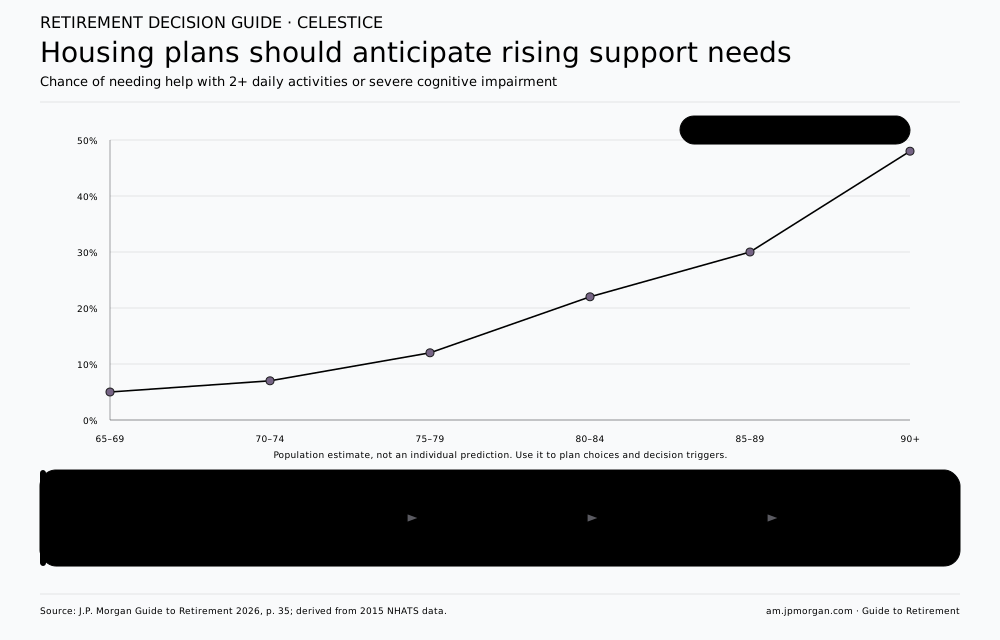
Frame the decision across life stages
Plan for phases rather than one permanent answer
Bank of America's housing guide describes retirement in three broad phases. The first is usually active, with greater independence, travel, work, and choice. A downshift phase may bring reduced mobility, less travel, higher medical spending, or a need for help around the home. A later phase may require substantial caregiving or a different living arrangement.
These phases are not assigned to particular birthdays. A health event, loss of a spouse, caregiving responsibility, financial change, or loss of driving ability can move a household from one phase to another quickly. Someone else may remain active for decades.
J.P. Morgan's 2026 general-population analysis estimates that a 65-year-old couple has a 47% probability that one person reaches 90 and an 18% probability that one reaches 95. An attractive five-year housing choice can become a poor 25-year fit.
Build the decision around at least three scenarios:
- The active household: both people are mobile, driving, and managing the home.
- The supported household: one person cannot drive, use stairs safely, or complete some daily tasks without help.
- The survivor or care household: one person lives alone or needs regular in-home or residential care.
The goal is not to predict the exact path. It is to avoid choosing a home that succeeds only in the first scenario.
The choices can overlap
Staying, downsizing, renting, relocating, and buying are not mutually exclusive. A household might relocate to be near family, rent for a year, then buy a smaller accessible home. Another might remain in the same community but move from a multilevel house to a condominium. Compare the combinations that are genuinely available.
| Choice | What it may provide | What deserves scrutiny |
|---|---|---|
| Stay and modify | Familiarity, established relationships, avoided moving costs | Maintenance, accessibility, transportation, isolation, future care |
| Downsize | Less space and upkeep, possible equity release | Transaction costs, storage, HOA fees, smaller-home pricing, another later move |
| Rent | Flexibility, fewer maintenance duties, easier trial of a location | Rent increases, lease security, modification limits, less control |
| Relocate | Family proximity, preferred climate, lower costs, better services | Lost community, insurance, taxes, health networks, family plans changing |
| Buy for the next stage | Purpose-selected layout, amenities, accessibility | Illiquidity, financing, upkeep, community fees, resale and exit options |
Compare the housing paths
Staying works only when the home and community work
Remaining at home can preserve routines and relationships while avoiding moving costs. With a manageable property, nearby services, reliable transportation, and a support network, it may be durable.
But “stay” should mean more than postponing a decision. Review the home before a crisis:
- Is there a step-free entrance or a practical way to add one?
- Can essential living occur on one floor?
- Are doors and hallways wide enough for mobility equipment?
- Can bathrooms accommodate grab bars, a shower seat, and safe transfers?
- Are lighting, flooring, stairs, and exterior paths safe?
- Can someone maintain the yard, roof, systems, and seasonal tasks?
- What happens when driving is no longer possible?
- Are groceries, prescriptions, medical care, and social activities accessible?
- Can in-home care providers work safely in the space?
- Would the home still function for a surviving spouse?
An occupational therapist or other qualified professional can assess daily-function and home-safety needs. AARP's HomeFit guide provides a room-by-room starting point. NCOA's 2026 guidance adds a broader test: health, safety, daily living, support, local services, finances, transportation, and future needs must work together.
Downsizing should improve more than square footage
A smaller property can reduce cleaning, maintenance, utilities, or yard work. Selling a larger home may also release equity for retirement spending, reserves, or other goals. Yet downsizing does not guarantee lower costs.
A newer condominium may have a higher price per square foot, association fees, special assessments, and limited control over increases. Moving, furnishing, and storage cost money. A smaller home may still have stairs or poor access to transportation and medical care.
Define the result before searching: less maintenance, lower annual spending, accessible living, closer family, or a better community. Then reject properties that are smaller but do not deliver the intended improvement.
Renting can buy flexibility
Renting shifts many repair responsibilities to a landlord and avoids tying another large share of wealth to one property. It can be especially useful when testing a new city, living near family temporarily, splitting time between locations, or waiting for a life-plan community.
Tradeoffs include rent inflation, possible nonrenewal, modification limits, and less control. A renter still needs reserves, insurance, moving capacity, and a care plan.
When comparing rent with ownership, do not compare monthly rent only with mortgage principal and interest. Compare total annual cash flow, transaction costs, investment opportunity cost, flexibility, and the likely length of stay.
Relocate toward a support system, not merely a destination
In the Merrill and Age Wave research summarized by Bank of America, 64% of retirees expected to move at least once and 37% had already moved. The leading reason given for a move was proximity to family. Those figures come from a 2015 study, so they describe that survey rather than today's entire retiree population, but the planning question remains important.
“Near family” needs an operational definition. Ask:
- How often will you realistically meet, and how much travel time separates you?
- Is family willing and able to provide rides, household help, advocacy, or care?
- What happens if an adult child changes jobs or moves?
- Does each spouse have relationships and activities beyond the nearby relative?
- Would shared housing preserve privacy and family boundaries?
- Who is the backup helper?
A move should benefit the retiree as a resident, not depend entirely on another household's address. Evaluate health care, transportation, walkability, climate and insurance risk, taxes, community, and opportunities to contribute as well as receive help.
Compare senior communities by services and risk
Senior housing is not one product. NCOA distinguishes independent living, assisted living, nursing homes, continuing care retirement communities (CCRCs), subsidized HUD Section 202 housing, member-supported Villages, cohousing, and aging in place. The useful question is what support is included now and what happens when needs increase.
Independent or 55+ living may provide amenities and social connection but not medical care. Assisted living adds daily help; skilled nursing adds ongoing medical care. A CCRC or life-plan community can place all three on one campus, often for an entry fee and monthly charges.
Review a CCRC contract with qualified legal and financial professionals. Type A generally shifts more future care-cost risk to the community; Type B includes limited care; Type C charges future care at market rates, leaving more long-term-care cost risk with the resident; rental structures may be pay-as-you-go. Examine refunds, eligibility, fee increases, occupancy, reserves, debt, transfer rules, and the operator's financial condition.
Buying requires a long-life test
Buying can provide control, stability, and the ability to modify the property. It can also lock capital into a home that may be costly to sell or unsuitable later. Before purchasing, test whether the property supports one-floor living, changing mobility, in-home help, and a surviving spouse.
Investigate property taxes, insurance, HOA reserves and assessments, maintenance, disaster exposure, and resale demand. Creative Planning also recommends coordinating a move with retirement income, Social Security, withdrawals, taxes, health care, long-term care, and estate planning.
The financing question deserves a separate analysis. Cash, a mortgage, portfolio sales, and blended funding can produce different tax, liquidity, and market-risk outcomes. See Buying a Retirement Home: Cash, Mortgage, or Portfolio Withdrawal? for that comparison.
Test the finalists
Calculate the full housing cost
J.P. Morgan's 2026 guide estimates that housing represents 40.7% of average spending for households age 75 and older, compared with 41.7% for ages 35 to 44. Its housing category includes mortgage payments or rent, property taxes, maintenance, utilities, and furnishings. These are population averages, not a target budget, but they show why housing remains central even after a mortgage ends.
Calculate each option in consistent categories:
- Recurring occupancy: rent or mortgage, property tax, insurance, HOA fees, utilities, parking, and routine services.
- Maintenance and reserves: repairs, major systems, landscaping, assessments, and deductibles.
- Transition costs: commissions, closing, moving, storage, furnishings, and overlap.
- Accessibility: entrances, bathrooms, lighting, flooring, doorways, lifts, and other modifications.
- Transportation: vehicles, rides, transit, deliveries, and health-care access.
- Support and care: household help, personal care, and caregiver space.
- Financial effects: taxes from asset sales, financing costs, liquidity used, home equity retained, and the opportunity cost of capital.
- Exit costs: the expense and practical difficulty of moving again.
Separate annual from one-time costs and use category-specific assumptions where possible.
“The right retirement home supports the life you want now without closing off the choices you may need later.”
Score the decision across three time horizons
Create one page for each serious option and score it from one to five on:
- total recurring cost;
- one-time transition cost;
- accessibility and adaptability;
- transportation and health-care access;
- family and community support;
- maintenance and management burden;
- liquidity and effect on the retirement portfolio;
- suitability for one spouse living alone;
- access to escalating care; and
- ease of exiting or moving again.
Weight the categories. If proximity to a specialist is essential, it should matter more than an extra bedroom. If maintaining a garden is central to daily life, do not let a generic downsizing rule erase it.
Watch this: A property that wins only while both people are healthy, driving, and independent is not yet a durable retirement-housing choice.
Stress-test every finalist against a few plausible events:
- one spouse dies;
- driving stops;
- weekly paid help becomes necessary;
- insurance, rent, or HOA costs rise sharply;
- the portfolio declines before a planned move;
- a family member who expected to help relocates; and
- the home must be sold during a weak local market.
Make the decision before a crisis makes it for you
Begin family conversations early and treat them as manageable discussions. A fall, hospitalization, or caregiver emergency compresses the timeline and narrows the choices.
Let the person most affected lead discussion of preferences, limits, care, and decision authority. Record a next action: assess the home, visit communities, test a seasonal rental, calculate moving costs, or speak with family.
Review the decision annually and after changes in health, mobility, marital status, caregiving, finances, transportation, or family location. A decision to stay is still a decision—and it needs conditions under which the plan will be reconsidered.
Let the housing plan adapt with Celestice
Housing choices become difficult when the property search is separated from the income, tax, portfolio, care, and family assumptions that determine whether a move will last. A home can look affordable today while creating a liquidity problem or another forced move under the survivor or supported-household scenario.
Celestice carries the scenario work forward after the initial decision. It continuously incorporates connected changes in home costs, balances, insurance, health and care assumptions, transportation, and family location, then retests each viable option under the same retirement framework. If the chosen path develops a liquidity gap, accessibility risk, or better-timed alternative, the AI partner brings that exception forward with the tradeoffs and prior reasoning attached.
Most of the work stays in the background. When a housing decision becomes material, the household can inspect the evidence, change the assumptions, approve the next step, or override the proposal—without surrendering control of a deeply personal choice.
This article is educational and is not individualized financial, tax, legal, real-estate, insurance, lending, or health advice. Costs, rules, and personal circumstances vary; consult qualified professionals before acting.
The bottom line
The best retirement housing choice is not necessarily the least expensive address or the home with the most emotional history. It is the setting that supports daily life, preserves relationships, fits the household's resources, and leaves a workable path for the next phase.
Let Celestice keep the housing decision from becoming an emergency. Your AI financial partner carries the financial and care scenarios forward as life changes, bringing you in while there is still time to choose.
Sources and further reading
- Bank of America: Housing in Retirement—Your Life, Your Choice
- J.P. Morgan Asset Management: Guide to Retirement 2026
- National Council on Aging: Senior Housing Options—A Complete Guide
- National Council on Aging: The Cost of Aging in Place
- Creative Planning: Housing in Retirement—Finding the Right Place to Call Home
- Merrill: Housing Options in Retirement—Where Should You Live?
- AARP: HomeFit Guide
- Administration for Community Living: Eldercare Locator