


A salary arrives on a schedule. Retirement income rarely does. Social Security may land on one date, a pension on another, dividends quarterly, bond principal annually, and a tax bill when no convenient deposit is due. Meanwhile, groceries, insurance, travel, home repairs, and gifts follow their own rhythms.
The solution is not to force every investment to produce monthly income. It is to build a household payment system between the portfolio and the checking account. That system can feel as steady as a paycheck while the assets behind it remain diversified and adaptable.
This guide starts after the broad readiness question. If you are still estimating the portfolio's role, begin with How Much Do I Need to Retire?. The framework below is educational, not personal investment, tax, or legal advice.
Key takeaways
- Separate essential spending, flexible wants, and irregular obligations before setting a monthly transfer.
- Give operating cash and reserve cash different jobs so the same dollar is not counted twice.
- Automate the household paycheck, but replenish it through written tax-aware and allocation-aware rules.
- Test the system for weak markets, lost income, major expenses, and a spouse who must take over the process.
Build the paycheck foundation
First define the spending floor—and the flexible life above it
One retirement budget number conceals the most useful distinction in the plan. Divide spending into three layers:
- The floor: housing, utilities, basic food, insurance, health care, minimum debt payments, and other costs that must be paid even after a difficult market year.
- Flexible wants: travel, dining, hobbies, gifts, home upgrades, and other valuable goals whose timing or amount can change.
- Irregular obligations: property tax, estimated taxes, insurance premiums, vehicle replacement, major maintenance, and family commitments that are predictable but not monthly.
The categories are personal. Golf may be optional to one household and central to another's retirement vision. The point is to identify what can change before a market decline forces an emotional decision. Fisher Investments' retirement-income guide uses a similar split between nondiscretionary and discretionary spending, then connects the result to inflation and the household's time horizon.
Convert annual and irregular costs into monthly sinking-fund amounts. A $6,000 property tax bill and $3,600 insurance premium are not surprises; together they require a $800 monthly provision. Keep true emergencies separate so the same dollar is not counted twice.
Build an income inventory before scheduling withdrawals
For every inflow, record the gross amount, expected net deposit, payment date, start and end dates, inflation treatment, survivor treatment, tax character, and how much control you have over timing.
| Income source | What to verify | Cash-management role |
|---|---|---|
| Social Security | Claiming date, COLA, tax withholding, survivor benefit | Inflation-sensitive lifetime floor |
| Pension | Single- or joint-life election, COLA, withholding | Stable floor, sometimes without inflation protection |
| Annuity | Insurer, guarantees, rider costs, liquidity, survivor terms | Contractual income for selected needs |
| Work, rent, or business | Variability, expenses, taxes, likely duration | Supplement, not necessarily a permanent floor |
| Interest and dividends | Amount and timing can change | Inputs to total return, not a complete paycheck plan |
| Portfolio withdrawals | Account type, tax lots, RMDs, sale timing | The controllable gap-filler |
Do not confuse income with spendable cash. Municipal interest can affect tax formulas; a traditional IRA distribution may be taxable even when it simply sits in checking; and a taxable-account sale can return both cost basis and gain. Build the calendar in after-tax terms, while retaining the gross figures needed for tax planning.
Fisher's guides make another useful distinction: portfolio cash flow does not have to come only from coupons and dividends. A planned sale from a diversified total-return portfolio can be an entirely legitimate source of cash. Chasing yield can distort the allocation, concentrate risk, and still fail to match the dates when bills arrive.
Use two cash layers, not one oversized pile
An effective paycheck system usually separates cash by job.
Operating cash lives in checking or another highly liquid account. It receives benefits and scheduled portfolio transfers and pays the next several weeks of bills. Its balance should absorb normal timing mismatches without becoming a large, idle investment allocation.
Reserve cash sits apart in an interest-bearing bank account, money market fund, Treasury bill, or other vehicle selected for liquidity and principal stability. It covers unexpected spending, a temporary income interruption, and—if the plan calls for it—a period when selling volatile assets would be undesirable.
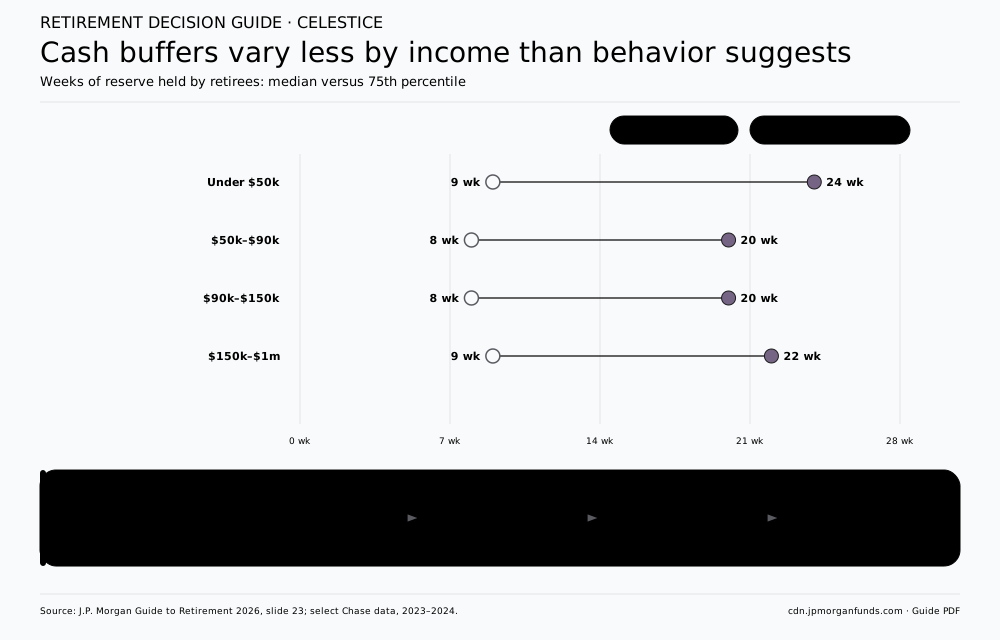
There is no universal reserve number. J.P. Morgan's 2026 Guide to Retirement suggests that retirees consider roughly three to six months of income for spending shocks, based on its household cash-flow research. A household with a large pension, modest portfolio gap, and strong insurance may need less than one whose expenses depend heavily on market withdrawals. Add known near-term purchases explicitly rather than hiding them inside a generic percentage.
Too little cash creates forced-sale risk. Too much creates inflation and opportunity cost: money intended for needs 15 years away may lose purchasing power if it never participates in long-term growth. Cash is a timing tool, not a substitute for the whole portfolio.
A paycheck example
Suppose a retired couple maps annual spending this way:
- essential floor: $74,400;
- flexible wants: $24,000; and
- irregular but planned expenses: $18,000.
Their annual target is $116,400. Social Security and a pension are expected to provide $72,000, leaving a $44,400 portfolio cash-flow gap, or $3,700 per month after making the plan's tax assumptions. They route benefits and a scheduled portfolio transfer to the operating account, then pay themselves the same amount on the first business day of each month. The $18,000 sinking fund accumulates inside the system until the scheduled bills arrive.
The transfer is not automatically the IRA distribution. If $3,700 is the desired net deposit, the gross withdrawal may be higher after withholding. Alternatively, some cash may come from taxable-account basis or maturing securities. The withdrawal source is a separate annual tax and investment decision; the household-facing paycheck can remain simple even when the funding mix is not.
Operate and protect the system
Write replenishment rules while markets are calm
Automation solves the monthly mechanics. Replenishment protects the next year. A workable policy might say:
- Direct Social Security, pension payments, interest, dividends, and maturities to the operating or reserve account as appropriate.
- Transfer the planned household paycheck monthly and review actual spending quarterly.
- Refill operating cash when it falls below one month's planned outflow; stop adding when it exceeds two months, unless a known bill is approaching.
- Restore the reserve at an annual or semiannual review using maturing bonds and sales from assets above their target weights.
- After a material portfolio decline, use scheduled maturities and reserve cash first, postpone nonessential increases, and decide whether flexible spending should fall.
- After strong returns, rebalance deliberately, rebuild depleted cash, and fund only those future wants already approved in the plan.
These are sample rules, not universal thresholds. What matters is that a percentage, date, and responsible decision-maker replace “sell something when cash gets low.” A reserve should also have a refill ceiling; otherwise caution can quietly turn a growth portfolio into permanent cash.
Decision rule: Automate the monthly household transfer, but require a scheduled review before selling assets or refilling the reserve.
Put taxes and RMDs on the same calendar
Cash planning and tax planning cannot be two separate annual exercises. Track estimated tax payments, withholding, Medicare premium effects, realized gains, and required minimum distributions alongside household bills. An RMD is a taxable distribution requirement, not a spending requirement. If it exceeds current spending, the net amount can be reinvested in a taxable account or assigned to a future goal. Eligible charitable households may want to evaluate qualified charitable distributions before an RMD is processed.
Also check which account will fund each refill. A traditional-account withdrawal, high-basis taxable sale, Roth distribution, and bond maturity can deliver the same cash but create very different current and future tax effects. See Taxes in Retirement for the income stack and Retirement Withdrawal Order for account-sourcing trade-offs.
“A retirement paycheck is not a product. It is a repeatable cash-management process that gives every dollar a job before the month begins.”
Design for bad years and human behavior
Cash can reduce the need to sell growth assets immediately after a decline, but it does not eliminate sequence-of-returns risk. Nor should the reserve become permission to ignore a plan that is off track. Stress-test at least these events:
- stocks fall early in retirement while inflation lifts the spending floor;
- one spouse dies and a benefit ends while taxes shift toward single-filer rules;
- health or long-term-care costs arrive sooner than expected;
- rental, consulting, or dividend income falls;
- a large home repair coincides with a tax payment; and
- diminished capacity requires a trusted person to operate the system.
For each scenario, name the first response, second response, and decision threshold. That might mean using reserve cash, pausing travel, completing a planned bond maturity, adjusting withholding, or convening an adviser and tax professional. The purpose is not to predict every emergency. It is to prevent a stressful week from becoming an unplanned portfolio strategy.
The annual paycheck checklist
- Reconcile the last 12 months of actual spending with the floor, wants, and irregular calendar.
- Confirm every income amount, deposit date, COLA, survivor provision, and withholding election.
- Recalculate the portfolio gap and monthly transfer; do not merely roll last year's number forward.
- Measure operating and reserve cash against their written floors and ceilings.
- Identify which maturities, distributions, and rebalancing trades will fund the next refill.
- Review RMDs, tax brackets, Medicare thresholds, estimated payments, and charitable plans before year-end.
- Test a poor-market year, an inflation shock, and a major expense without counting the same reserve twice.
- Record who can see, approve, and execute the plan if either spouse cannot.
Let Celestice run the paycheck coordination
The recurring problem is coordination. Income arrives on different dates, the spending gap changes, investments mature, taxes alter the gross withdrawal, and a reserve can fall below target without any one statement showing the whole system.
Celestice takes on that coordination continuously. It folds connected deposits, balances, spending, reserve limits, tax assumptions, and portfolio rules into the cash-flow plan, then recalculates the funding path as conditions change. If the next paycheck is at risk, a reserve moves outside policy, or a refill creates a tax or allocation tradeoff, it prepares the relevant choices instead of leaving the household to reconcile statements.
The routine work stays in the background. Celestice brings forward an exception only when a decision or approval is useful, with the evidence and assumptions attached. The household or its professionals can inspect the reasoning, change the inputs, approve a course, or override it before a consequential action.
The bottom line
A retirement paycheck feels dependable because the decisions behind it are visible and repeatable—not because every asset promises a fixed yield. When the income inventory, cash calendar, reserves, tax plan, and replenishment rules work together, the household can focus less on the next bill and more on the retirement those dollars are meant to support.
Let Celestice do the ongoing cash-flow work. Keep the routine on autopilot, get a clear decision when the next paycheck or reserve policy needs attention, and remain free to inspect, change, approve, or override the plan.
Sources and further reading
- Morningstar: The State of Retirement Income: 2025
- J.P. Morgan Asset Management: Guide to Retirement (2026 edition, especially pages 23, 28–39)
- Northern Trust Asset Management: Cash Flow Management for the Critical Financial Goals
- Fisher Investments: Retirement planning resources, including The 15-Minute Retirement Plan and The Definitive Guide to Retirement Income (2025 editions)
- IRS Publication 915: Social Security and equivalent railroad retirement benefits
- IRS: Retirement plan and IRA required minimum distributions FAQs
- Consumer Financial Protection Bureau: Planning for retirement